







Your guide to credit card offers and deals
Most credit cards in Australia come with some form of intro offer to incentivise customers to sign up. It’s something consumers have come to expect, particularly on rewards credit cards and frequent flyer credit cards.
In fact, Money.com.au’s database shows only around 15% of cards don’t have any sign-up offer at all, whether it’s bonus points, cashback, a 0% balance transfer offer or a fee waiver.
Some cards even offer a few different intro offers to choose from when you sign up. But just like the cards themselves, deciding which kind of sign-up offer will be best for you is not necessarily straightforward.
Below we breakdown the different kinds of offers and how they work.
Different kinds of credit card offers explained
Bonus rewards points
How it works: Bonus points for signing up is what probably comes to mind for most people when they think of a credit card special offer. What usually happens is new customers must spend a certain amount using the card within the first few months, and in return they get a lump sum of rewards points credited to their account.
The reason for the minimum spend is credit card companies typically get a small cut when you use your credit card for a purchase. Making the bonus points conditional on you spending, say, $5,000 in the first three months with the card means the card issuer is earning revenue. This offsets the cost of the bonus points they’re ‘giving away’. It also gets you into the habit of spending with the card early on. The minimum spend is usually pretty achievable.
Typical offer amounts: Sign-up offers usually range from 20,000 to 250,000 bonus points. Providers usually offer a higher number of bonus points on their own rewards program, with lower bonuses available on Qantas credit cards and for Velocity point offers.
What’s the catch? As an added eligibility hurdle, it’s becoming more common for bonus sign-up point offers to be spread across the first two years. So you get the first batch of points in year one if you meet the minimum spend, and then another batch after 12 months with the card. There may even be a further minimum spend requirement for the year-two points to make things even more complicated.
Spreading the bonus over two years means the cardholder will need to pay two years’ worth of annual card fees. It also makes it less appealing for customers to ‘churn’ credit cards, which means repeatedly taking out new credit cards to get the bonus points and then cancelling when the points are spent.
Bonus intro points earn rate
How it works: This is much less common, but some credit cards (the HSBC Platinum Qantas Credit Card is an example) offer a higher points earn rate in the first year as a sign-up bonus of sorts. The incentive is ultimately the same – more rewards points at the start to get you on board.
Typical offer amounts: As an example, you might earn 1.5 points per $1 spent in the first year with the card and then 1 point per $1 you spent after that.
What’s the catch? In most cases, a lump sum at the start is going to deliver more impact for your points balance. Unless of course, you happen to be a phenomenally big spender in which case earning more per dollar you spend may be a better initial deal.
Ultimately, you’ll probably be better off with a card offering a high ongoing earn rate and bonus points for signing up.
Bonus cashback
How it works: Sometimes offered instead of or in addition to bonus points, cashback on a credit card usually comes in the form of a credit to your account. You can then use that credit for a purchase, or just use it to reduce your existing balance.
Getting cashback as a sign-up bonus is arguably more valuable than points as the value is guaranteed. Rewards points, on the other hand, vary in value from one program to the next and also in terms of how they’re spent. It’s not easy to objectively put a value on 100,000 bonus points, but $500 cashback is worth $500.
Typical offer amounts: The amounts on offer usually range from $250-$500 and are generally also conditional on the cardholder meeting a minimum spend in the first few months with the card.
What’s the catch? These offers are much less common compared to bonus point offers. If you have your heart set on cashback, you’ll have much fewer cards to choose from.
Annual fee waiver/discount
How it works: There are a lot of credit cards with no annual fee in the first year, or a discounted fee for the first 12 months. This is probably the simplest of all the credit card promotional offers to get your head around, with a clear unambiguous benefit.
Everything else about the card will be the same in that first year, you just don’t need to pay an annual fee.
In some rare cases, the fee is charged initially but then refunded if you meet certain conditions, like spending a minimum amount with the card. But usually that’s not the case and it’s a simple free kick.
Typical savings: The savings in the first year can range from around $500 all the way up to $500.
What’s the catch? When the party’s over you’ll need to pay the full annual fee in the second year with the card. This kind of offer might encourage you to get a more expensive card than you otherwise would if you were paying full wack from day one.
Intro interest-free offer
How it works: Interest-free credit card offers are becoming less and less common, but some cards do still offer this as a sign-up deal to entice new customers. So let’s say you have a card offering 0% on purchases for six months – you won’t be charged interest on any purchases made using the card for the first six months. Pretty simple.
It can be a very useful type of bonus offer if you have a large expense to cover and want to repay it over a few months with no interest.
Typical offer durations: Offer durations generally range from 6-12 months, with 15 months being about as good as it gets.
What’s the catch? If you haven’t cleared the balance during the offer period, the ongoing purchase rate will kick in. That rate may be quite high.
0% balance transfer offer
How it works: 0% balance transfer credit card offers are very common in Australia. In a nutshell, what that means is you can transfer a balance from another credit card to the new one and you won’t pay any interest on that balance on the new card during the offer period.
It makes it easier to pay down debt and can save you a lot of money if you have a big balance that’s racking up interest.
Typical offer durations: Offer durations usually ranging from 6-26 months, with 12 months being the average.
A trend we’re seeing more of at Money.com.au is cards offering a reduced interest rate (but not 0%) on balance transfers for a longer period of time. So instead of the offer being 0% on a balance transfer for 12 months, you pay 5.99% p.a. for 36 months. This may suit if it’s going to take you a long time to pay off the balance completely.
What’s the catch? After the offer period, a much higher interest rate will apply. It’s also generally very expensive to make new purchases using the card during the offer period.

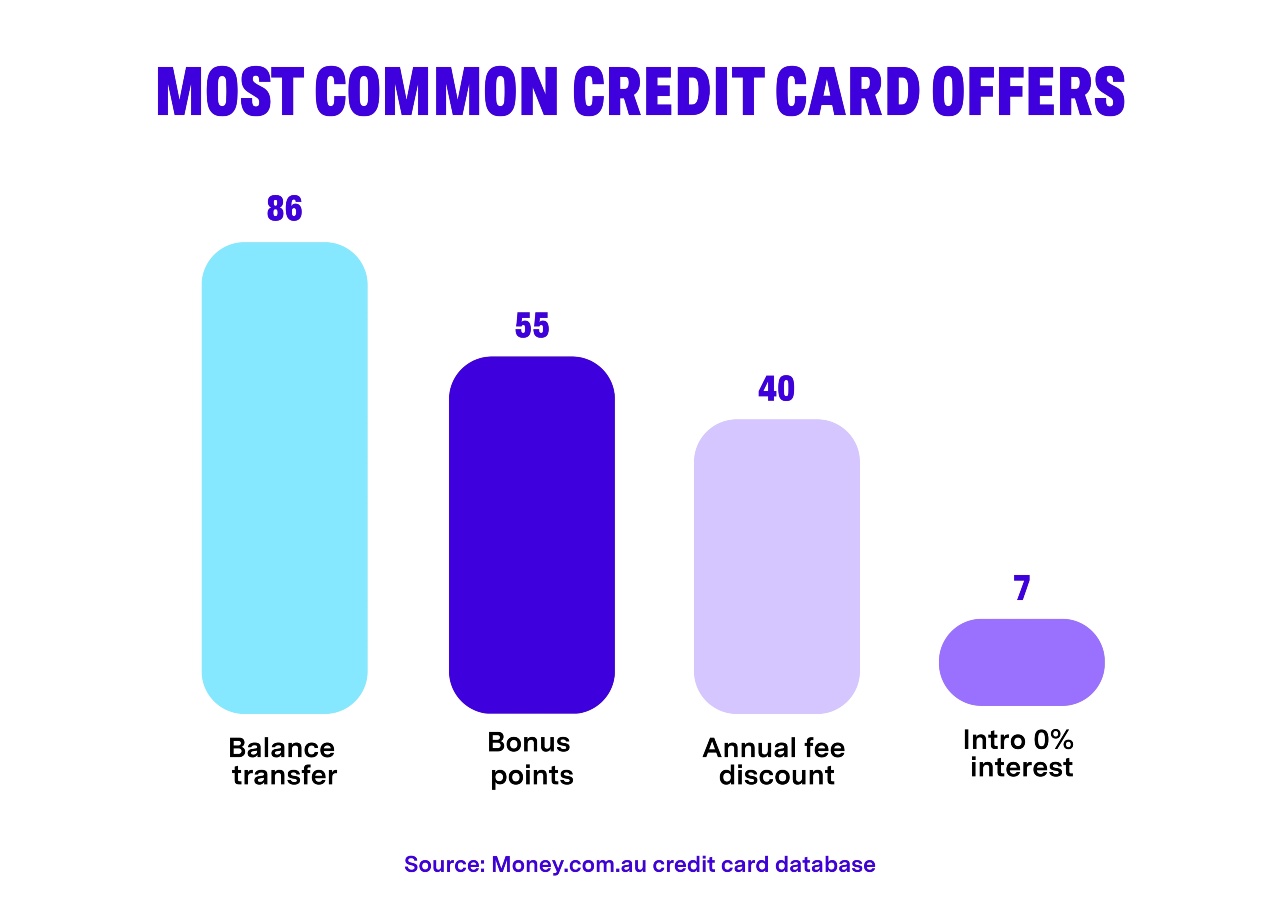
According to Money.com.au's credit card database, a balance transfer is the most commonly offered credit card promotion (86 different cards offer this), followed by bonus points (55), annual fee waiver/discount (40) and 0% interest offer (7).
What makes a good credit card promotional offer?
It has a clear value
An absolute bagful of bonus rewards points linked to an obscure rewards program may be very valuable, or they could be worth a lot less than a lower number of points linked to a better program. If you can’t easily work out what the points are worth, it may be best to keep looking for a more tangible benefit.
It’s something you’ll use
Even if the bonus is valuable on the face of it, is it valuable to you based on how you shop and spend? For example, if you can’t redeem the bonus points for the things you want, the value will be heavily reduced in reality. Flexibility is arguably just as important as the raw number of points.
It’s easy to qualify for
Avoid bonus credit card offers that require big minimum spends or other restrictive eligibility criteria. You don't want to end up jumping through potentially expensive hoops. In other words, the juice needs to be worth the squeeze. Timing matters too. All other things being equal, you’re better off with an offer where you actually get the benefit sooner rather than later.
It’s part of an overall competitive offering
Signing up for an expensive credit card or one with limited ongoing benefits is rarely a good idea, even if you get a sweetener for signing up and you only plan to keep the card long enough to cash in on the bonus offer. There are enough offers available that you should be able to find one on a card that’s a good fit for you and competitive overall.
It’s not going to encourage bad habits
How you use your credit card initially is likely to dictate how you use it over the longer term. At least to some extent. Avoid offers that are conditional on you spending big at the start. There’s always the risk that this spending pattern might stay with long after the bonus offer’s been and gone.
Nearly half of Australians with a credit card (49%) are ‘churners’ and admit to signing up for new cards only to collect bonus rewards points, Money.com.au research shows.
Among them, 30% say they’ve done it once or twice to boost their points balance, while 19% regularly sign up for new credit cards specifically to collect bonus rewards points.
Should you get a credit card with a bonus offer?

Sean Callery, Editor
Let’s break this down into the two main categories of credit cardholders: those looking to earn rewards and those looking to keep costs down.
If you’re looking to maximise rewards, the nature of how rewards credit cards work mean bonus offers are a big part of the overall value you get over the life of the card.
Bonus points or cashback (assuming you don’t have to change your good spending habits to qualify) will help offset the cost of the card, so the ongoing benefits the card offers cost less.
And there are enough offers in the market to make it possible for most people to find a credit card that suits their needs with an offer attached.
If, on the other hand, you really just want to keep costs down, bonus offers should be much less of a priority. Unless, of course, it’s a first-year annual fee waiver or interest-free offer on an already-cheap card. Then why not!
Sean Callery, Editor
Now might be as good a time as any to take advantage of a credit card sign up offer. Upcoming changes to Australia's payments system (being introduced on 1 October 2026) will mean credit card companies will make less money from customers using their cards for spending. This will likely lead to less generous benefits and sign-up offers in future as card providers look to reduce costs.
How we chose the credit card offers on this page
This page features the top credit card offers on Money.com.au’s database of more than 200 consumer credit cards (we compare business credit cards separately). We’ve broken down the cards into offer categories, with the top cards in each category shown in our comparison.
Our inclusion and sort criteria are pretty simple:
- Bonus point offers: We show the top offers from our database based on the highest total number of bonus rewards points of offer.
- Cashback offers: We show the top offers from our database based on the highest total value of cashback available as a bonus offer.
- First year annual fee waivers: We show the cards offering the largest discount on the first-year annual fee (i.e. the offer that represents the biggest customer saving)
- Interest-free introductory offers: We show the top offers from our database based on the longest promotional 0% interest offers.
- Balance transfer introductory offers: We show the top offers from our database based on the longest promotional 0% balance transfer offers.