


dsl-logo

Home Loans

Personal Loans

Car Loans

Business Loans

Credit Cards

Banking

Health Insurance

dsl-logodsl-logo
dsl-logo

Home Loans

Personal Loans

Car Loans

Business Loans

Credit Cards

Banking

Health Insurance

money logo

Renovation Home Loans: Refinancing For Renovations

Compare home renovation loan options and get expert help from a broker to refinance or restructure your loan, so you can make the most of your home upgrade.

Michael Burgess
Katey Russo Money.com.au Mortgage Broker
Nick Burgess - Money.com.au Mortgage Broker

Refinance with support from our trusted team of home loan brokers. Updated 24 Apr 2026.

Renovation home loan

Featured Offers

Sponsored

Partner Offer

loans.com.au home loans logo

Interest rates from

5.79%

p.a.

Comp. rates from^

5.83%

p.a.

Variable Bare Home Loan 90% LVR

Borrow up to $2m with competitive variable rates from 5.79% p.a. (comparison rate^ 5.83% p.a.). Enjoy flexible payment options, zero monthly or ongoing fees, unlimited free redraws and up to 30 year terms. 90% Max LVR applies. Visit site for T&Cs and to check eligibility.

SPECIAL OFFER

ubank

Interest rates from

5.84%

p.a. (owner occupied, P&I up to 60% LVR)

Comp. rates from^

6.08%

p.a. (owner occupied, P&I up to 60% LVR)

Ubank Flex Variable Home Loan

Win a year of your repayments up to $100k with Ubank. Apply for a new $250K+ Ubank home loan between 9 Mar and 30 Apr and settle by 31 Aug 2026 for your chance to win. Credit criteria apply. Permits, excl & T&Cs at ubank.com.au/win.

CHANCE TO

WIN!

Compare home renovation loan options

Find your best rates on a home renovation loan, with hundreds of products available for borrowers looking to refinance for home improvements.

refresh

Rates updated 24 April 2026

Important Disclosures

Loan amount

ProductInterest rate
Comparison rate
Monthly repayment
Key featuresCompare Now
undefined logo

Loans.com.au Variable Bare Home Loan 90% LVR

5.79%
p.a. variable
5.83%
p.a.
$2,931
Principal & Interest

Max LVR 90%

Redraw

undefined logo

UBank Flex Home Loan Variable (Owner Occupied)

5.84%
p.a. variable
6.08%
p.a.
$2,947
Principal & Interest

Max LVR 60%

Offset

Redraw

undefined logo

in1bank in1home

5.08%
p.a. variable
5.13%
p.a.
$2,709
Principal & Interest

Max LVR 50%

Redraw

undefined logo

in1bank in1offsethome

5.18%
p.a. variable
5.62%
p.a.
$2,739
Principal & Interest

Max LVR 50%

Offset

Redraw

undefined logo

Laboratories Credit Union Simple Home Loan Owner Occupied

5.44%
p.a. variable
5.46%
p.a.
$2,820
Principal & Interest

Max LVR 95%

App Fee $200

undefined logo

Pacific Mortgage Group Owner Occupied Variable Home Loan

5.59%
p.a. variable
5.59%
p.a.
$2,867
Principal & Interest

Max LVR 80%

Redraw

undefined logo

Virgin Money Lite Home Loan Variable

5.59%
p.a. variable
5.61%
p.a.
$2,867
Principal & Interest

Max LVR 60%

Redraw

Split Loan

undefined logo

Gateway Bank Green Plus Home Loan

5.60%
p.a. variable
5.89%
p.a.
$2,870
Principal & Interest

Max LVR 80%

Offset

Redraw

undefined logo

People First Bank Basic Variable Home Loan

5.64%
p.a. variable
5.65%
p.a.
$2,883
Principal & Interest

Max LVR 70%

Offset

Redraw

undefined logo

People's Choice Credit Union Basic Variable Home Loan

5.64%
p.a. variable
5.65%
p.a.
$2,883
Principal & Interest

Max LVR 70%

Offset

Redraw

undefined logo

RACQ Bank Fair Dinkum Home Loan

5.64%
p.a. variable
5.65%
p.a.
$2,883
Principal & Interest

Max LVR 60%

Split Loan

undefined logo

Gateway Bank Low Rate Essentials

5.64%
p.a. variable
5.66%
p.a.
$2,883
Principal & Interest

Max LVR 50%

Redraw

undefined logo

Gateway Bank Low Rate Essentials

5.64%
p.a. variable
5.66%
p.a.
$2,883
Principal & Interest

Max LVR 60%

Redraw

undefined logo

Heritage Bank Discount Variable OO P&I

5.64%
p.a. variable
5.66%
p.a.
$2,883
Principal & Interest

Max LVR 70%

Redraw

Split Loan

undefined logo

Police Credit Union Low Rate Home Loan Special Offer

5.64%
p.a. variable
5.67%
p.a.
$2,883
Principal & Interest

Max LVR 80%

Offset

Redraw

undefined logo

Australian Mutual Bank GumLeaf Basic Variable Rate Owner Occupied

5.64%
p.a. variable
5.71%
p.a.
$2,883
Principal & Interest

Max LVR 60%

Redraw

App Fee $250

undefined logo

Freedom Lend FREEDOM VARIABLE

5.64%
p.a. variable
6.03%
p.a.
$2,883
Principal & Interest

Max LVR 60%

Offset

Redraw

undefined logo

Horizon Bank Home Sweet Home Loan

5.64%
p.a. variable
6.34%
p.a.
$2,883
Principal & Interest

Max LVR 70%

Offset

Redraw

undefined logo

The Mac Credit Union Discounted Basic Variable Home Loan

5.67%
p.a. variable
7.33%
p.a.
$2,893
Principal & Interest or Interest only

Max LVR 80%

Redraw

App Fee $400

undefined logo

Bank of China Discount Home Loan - Australian Income

5.68%
p.a. variable
5.89%
p.a.
$2,896
Principal & Interest

Max LVR 80%

Redraw

undefined logo

Bank of China Discount Plus Home Loan - Australian Income

5.68%
p.a. variable
6.07%
p.a.
$2,896
Principal & Interest

Max LVR 80%

Offset

Redraw

undefined logo

Unloan Refinance

5.69%
p.a. variable
5.60%
p.a.
$2,899
Principal & Interest

Max LVR 80%

Redraw

How much can you cash out for renovations?

See how much equity you may be able to draw down for renos, based on your current loan balance and property value.

Home equity loans

Calculate your usable equity

Refinance calculator

How do home renovation loans work?

If you’re considering a renovation loan for a home upgrade, refinancing your existing home loan can be a smart way to do it. Essentially you’re ‘topping up’ your loan to borrow the extra money to finance the reno.

It’s generally only possible if you have enough equity in your property, but most borrowers who have had their loan for a few years should be in a position to draw down some equity.

Equity just means the difference between your loan amount and what your property is worth. For renovations, most lenders will allow you to extend your total loan balance to up to 80% of your property’s current value.

So let’s say your current home loan balance is $700,000 and your property is worth $1,000,000. You may be able to cash out an additional $100,000, bringing your new loan total to $800,000, or 80% of the property’s current value. The extra $100,000 becomes your renovation loan to finance your home improvements.

Note, it may be possible to borrow more than 80% of your property’s value in some cases. But if your loan-to-value ratio (LVR) goes above 80%, you may need to pay for lenders mortgage insurance, which would significantly add to the cost of your reno.

moneyLogo

On average customers who refinance their mortgage through Money.com.au have around $345,000 in usable equity that they can potentially access for renovations or other purposes.

Structuring your loan to suit your renovation

There are two main ways you could structure your home renovation loan once the lender has agreed to lend you the extra funds.

coins-hand

Top-up

This involves a straightforward increase to your existing home loan with the reno funds added to your balance.

sale

Loan split

Separate the extra funds into a dedicated renovation home loan account, with interest-only repayments.

Money.com.au Mortgage Broker, Nick Burgess, explains that the separate renovation loan splite is what most borrowers choose once he explains how this works and the flexibility it offers.

“When they come to us, a lot of borrowers aren't aware that they can create this separate loan for the renovations and set it up with interest-only repayments,” says Nick.

“The benefit, particularly for bigger renos, is that the funds can just sit there until the homeowner is ready to actually start building. Because it’s interest-only, there are no repayments on that debt until they use the cash and interest starts accruing."

Why clients often choose a split renovation loan

Nick Burgess - Money.com.au Mortgage Broker

Nick Burgess, Money.com.au Senior Mortgage Broker

“The reason this works well is a lot of borrowers don't know when exactly they're going to start the renovations. They might be trying to find a builder and the start date could be six months away.

In the meantime, the funds for the reno just sit there ready to go with no repayments required. If, on the other hand, the renovation loan was on principal and interest, as soon as that money hits the borrower’s account, they've got a minimum repayment to make to the bank.

That means the budget available for the reno is going to keep dropping down with each repayment. So if they're budgeting a certain amount for the reno, that may not be the best way to structure the loan.”

Nick Burgess, Money.com.au Senior Mortgage Broker

Benefits of the right renovation loan

Let’s use the example of that extra $100,000 borrowed for renovations, where the building work doesn’t commence for six months. The renovation loan funds go into a separate interest-only loan account with the balance fully offset using an offset account or redraw facility until the building starts. Because of this, the borrower doesn’t need to pay anything until the funds are drawn down.

In an alternative scenario, had those funds simply been added to the borrower’s existing balance (with principal and interest repayments), their monthly loan repayments would have increased by $644 per month*, or an extra $3,864 over six months. That amount would include $3,000 in interest payable on the renovation funds before any work is done, with $864 of the loan paid back.

Starting to repay the extra renovation loan funds from day one is not ideal for two reasons:

  • You’re depleting your renovation funds i.e. paying the money back to the bank before you’ve used it.
  • Unless you can keep the money in an offset account or redraw facility, you’re paying interest on the amount you borrowed.

If your loan doesn’t have an offset account or redraw, you could always stash the money in a high interest savings account until you need it to pay your builder, but the separate loan is often a cleaner solution. That said, it’s worth discussing this strategy with a mortgage broker and how it might apply to your situation.

*Assumes a 6% p.a. interest rate and 25-year remaining loan term.

Case study: Renovation refinance

Money.com.au’s Editor, Sean Callery, explains how he refinanced his mortgage to fund a home renovation project.

“We had two bathrooms badly in need of a complete remodel and some equity in our property to play with, so we decided to refinance our home loan and cash out the money to pay for the work.

Here’s what we did step by step:

  • We decided on the scope of the project and got three builders to quote for the work, then chose a builder and paid a deposit to secure a start date.
  • With a budget locked in, we talked to our lender about our plans and how much we needed.
  • We went through a fairly thorough refinance loan application where the lender assessed our income, bank statements and other loans and credit cards.
  • After a few days, the finance was approved and about a week later the funds for the reno were paid into our offset account.
  • As it happened, we had some cash available to redraw from our existing loan, so part of the reno funds were simply paid back to us using that money. This reduced the amount of new borrowing.
  • We used the loan funds to pay the builder as the invoices came due. There was a bit left over and we resisted the temptation to keep buying expensive bathroom accessories and instead paid that money back into the loan to lower our balance and save on interest."

Et voila! Before and after…
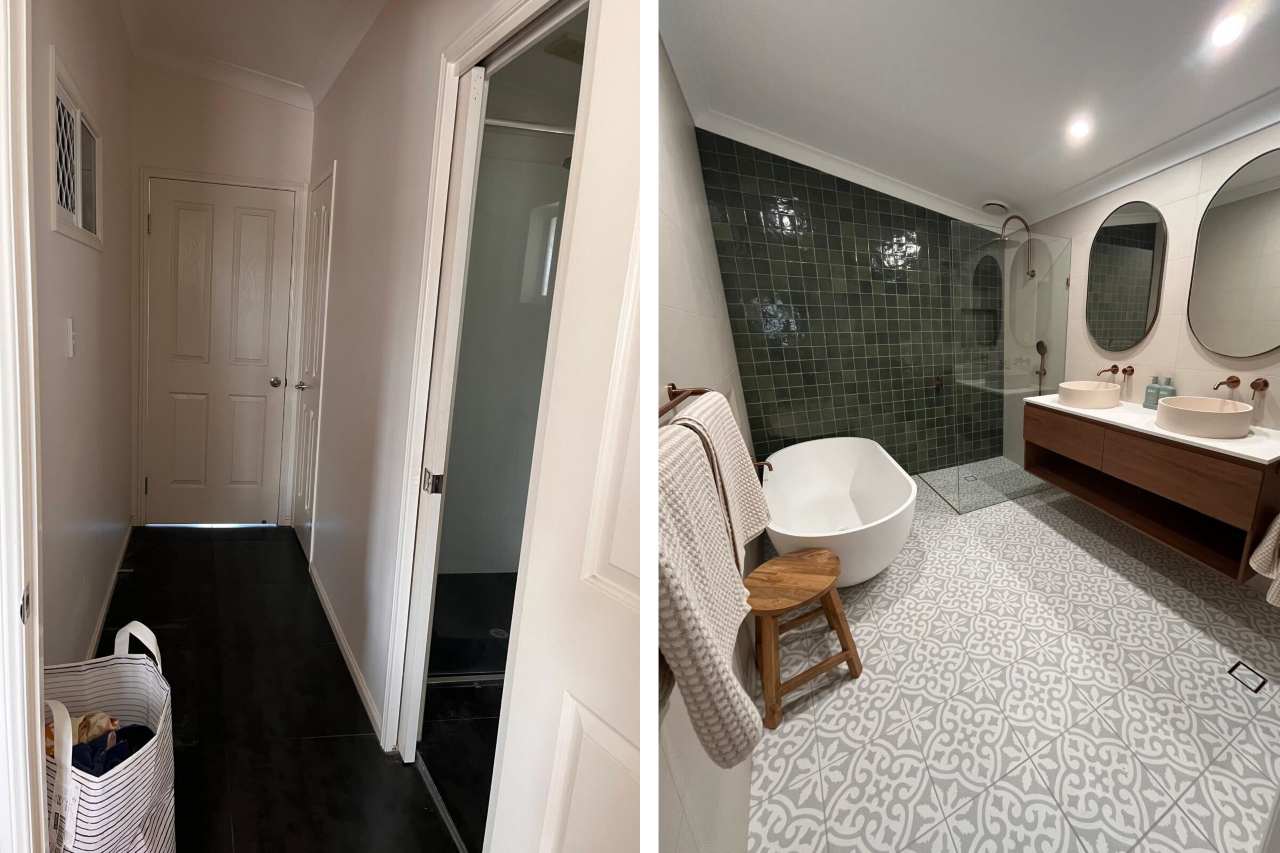
Home reno before and after

The main complication with our home renovation loan

Sean Callery Editor Money.com.au

Sean Callery, Editor

"To throw a slight spanner in the works early on, one of the builders we spoke to insisted that due to the high demand for their services, they would only quote on jobs if there was renovation finance approved and ready to go.

This was our preferred builder, so I explained that we needed to establish our budget before approaching our lender and thankfully they were flexible. But it’s a good reminder that there can be a chicken-and-egg scenario in terms of which should come first: establishing the budget for the renovation by getting builder quotes, or establishing the budget for the renovation by seeing what a lender will give you.

The reality is some builders won’t give a quote without finance, and some lenders won’t give finance without a quote."

Sean Callery, Editor

How to qualify for a loan for renovation

To qualify for a renovation refinance, these are the main criteria that apply across Money.com.au’s panel of lenders:

  1. Do you have enough equity?

    You’ll need to have enough usable equity in your home to borrow against. For most lenders, your total loan balance (including the extra renovation loan funds) can be a maximum of 80% of your property’s current value. In other words, your current loan will need to be less than 80% in order for you to be able to borrow more.

  2. What’s the value of your property?

    To assess your borrowing capacity, you’ll need to have your property valued by the lender. In a lot of cases, this involves a simple ’desktop’ valuation where the lender uses online resources to estimate your property’s value. For more complex applications a physical inspection of your property may be ordered.

  3. Is the reno structural or non-structural?

    The lender will want to know if the renovations are structural or non-structural. For non-structural upgrades (e.g. remodelling a kitchen or adding a pool), a simple loan top-up may be all that’s needed. If it’s a structural upgrade (e.g. adding an extra floor), you’ll likely need a construction loan instead.

  4. Are you an owner-builder?

    The lender will want to know if you’re doing the work yourself (or project managing it yourself) or working with a separate builder or project manager. In most instances, lenders are reluctant to lend to owner-builders for renovations as they view this as being riskier.

  5. Can you service the loan?

    The lender will also assess your current income, expenses and other debts to ensure that you can service (i.e. afford) the higher repayments on the loan with the extra reno funds added to it.

How we got a recent client approved when his bank said ‘no’

Nick Burgess - Money.com.au Mortgage Broker

Nick Burgess, Money.com.au Senior Mortgage Broker

"A client came to us looking for help with a $60,000 cash out for a reno after his original lender said no. The lender was undervaluing his property based on an automated valuation and he was stuck. So I approached three other lenders on the client’s behalf and ordered valuations on the property. The valuations came back higher than what the original lender was quoting, putting my client in a much stronger equity position and we were able to get his renovation refinance approved."

Nick Burgess, Money.com.au Senior Mortgage Broker

Home renovation loan FAQs

You can’t use a renovation loan for structural upgrades to your home, such as adding an extension or lifting up and adding a floor. But aside from that, most lenders do not have restrictions on what the loan funds can be used for. If you’re approved for a loan top-up, the funds are generally simply paid to you and it’s up to you how to spend them.

For a straightforward cash-out refinance for renovations, the lender won’t ask to see a builder quote or plans for the building work. If you’re refinancing with a mortgage broker, the lender will simply rely on the broker’s notes regarding the renovation plans when assessing the application.

However, for larger projects involving a construction loan, the lender will want to see detailed quotes, building plans and council approval.

A borrower can typically qualify for a ‘green upgrade’ home loan if they already own a property and are making energy-efficient upgrades to it, like adding solar panels, batteries, insulation or efficient heating and cooling. Most lenders only offer these products if you already have your home loan with them, or become a customer by switching across.

ING and CommBank are among the lenders offering green upgrade home loans in Australia. They generally come with lower rates versus a standard home loan.

These loans are usually offered as a top-up or additional borrowing on an existing home loan, so you’ll need to have enough equity in your property to qualify.

Renovation loans and construction loans are both designed to fund property improvements, but they’re structured quite differently because of the level of risk involved.

A renovation loan is typically used to upgrade or extend an existing home, where the property already has a baseline value. In contrast, a construction loan is used to build a new home (or complete a knockdown rebuild or major structural renovation), where the final value depends entirely on the build being completed.

Because of this, construction loans are more tightly controlled. Lenders usually release funds in stages and require a licensed builder and detailed contracts. Renovation loans are simpler, with funds provided upfront via top-up to an existing home loan and more flexibility around how the work is carried out. The table below shows the key differences side by side:

Renovation loanConstruction loan

Purpose

Upgrade or improve an existing property

Build a new home, major knockdown/rebuild or structural reno

Loan structure

Lump sum or loan top-up

Progressive drawdowns with funds released in stages as build progresses

Builder requirement

No specific requirement

Requires a licensed builder

Documentation

Usually none required

Fixed-price contract, plans, council approvals

Complexity

Simpler, faster approval

More complex with inspections at each stage

Potentially, but it’s unlikely to make a significant difference in the short term as lenders tier interest rates based on the borrower’s loan-to-value ratio and any increase to your property will be at least partially cancelled out by the increase in your loan size.

The best way to save money on your renovation finance is to shop for the cheapest home loan rates and fees. Refinance costs can be high depending on the situation, so applying for the renovation loan with your current lender can be a cost saver. But if switching means you can qualify for a lower rate, it’s often worth the upfront cost to switch.

Beyond that, the right loan structure, such as interest-only repayment until the build is complete, can help you save money. Chat to a mortgage broker about this to ensure it suits your needs.

Once the building work is complete, paying extra on your loan whenever you have cash to spare will help you lower your interest costs.

They’re paid out as part of the refinance and closed. You’ll then focus on a single home loan repayment, so be careful not to re-use cleared credit cards or re-borrow.

Once your other debts are rolled into your mortgage, your home becomes the security for the entire loan. If you fall behind on repayments and can’t catch up, the lender can reclaim and sell your property.

But this doesn’t happen overnight. Lenders must follow strict processes and will usually offer hardship options or repayment plans first if you’re struggling. Seeking help early greatly reduces the risk of repossession.

Yes it’s possible to refinance an investment home loan to cash out funds for a renovation. It’s typically less common on investment loans, however, as investors tend to be less likely to do non-structural renovations on a property. More often than not, investors focus on structural renovations that will help to add significant value or improve the rental yield on their property. What are some other ways to finance a home renovation?

If you have been paying back extra on your home loan over time, it’s worth seeing how much funds you have available to redraw (if your loan offers this). You may be able to partially fund your reno this way rather than borrowing additional money. The same goes if you have money in your offset account, it may be easiest to use these funds instead of borrowing more.

For smaller renos, you could also consider a personal loan to cover the cost. Personal loan rates are generally higher than home loan rates, but the approval process is usually simpler, meaning you may be able to get your hands on the money sooner compared to applying for a home loan top-up.

Sean Callery is the Editor of Money.com.au. He has over 15 years of international experience. He is qualified with a Certificate IV in Finance and Mortgage Broking (FNS40821) and is compliant to provide general advice in Tier 1 General Insurance (RG 146) products.

Isabella Visser is a Finance Writer with Money.com.au. With her experience in journalism and writing content across multiple platforms she makes finance simpler for readers by creating insightful and engaging content.

Divider
logologo
logo

Our Money Promise

Money Pty Ltd (trading as Money) (ABN 42 626 094 773) Australian Credit Licence 528698 provides information about credit products. Money does not compare all products or issuers available in Australia. We are not a broker or credit provider and when we provide information via this website, we are not providing you with a recommendation or suggestion about a particular credit product. We may receive a commission when you apply for a home loan as a result of outbound links on this website.

This material has been prepared by Money Pty Limited (ABN 42 626 094 773) (Money, ‘us’ or ‘we’). Money is a corporate authorised representative (CAR 001318745) of 62 Consulting Pty Limited (ABN 88 664 809 303) (AFSL 548573) (62C). The material is for general information only and is not an offer for the purchase or sale of any financial product or service. The material is not intended to provide you with financial or tax advice and does not take into account your objectives, financial situation or needs. Although we believe that the material is correct, no warranty of accuracy, reliability or completeness is given, except for liability under statute which cannot be excluded. Please note that past performance may not be indicative of future performance and that no guarantee of performance, the return of capital or a particular rate of return is given by 62C, Money, any of their related body corporates or any other person. To the maximum extent possible, 62C, Money, their related body corporates or any other person do not accept any liability for any statement in this material.

The information on this website is intended to be general in nature and has been prepared without considering your objectives, financial situation or needs. You should read the relevant disclosure statements or other offer documents prior to making a decision about a credit product and seek independent financial advice. Whilst Money.com.au endeavours to ensure the accuracy of the information provided on this website, no responsibility is accepted by us for any errors, omissions or any inaccurate information on this website.

Interest rates, fees and charges are subject to change without notice. Before acting on any information, you should confirm the interest rates, fees, charges and product information with the provider. For clarity, where we have used the terms “lowest” or “best” these relate solely to the rates of interest offered by the provider and not on any other factor. The application of these terms to a particular product is subject to change without notice if the provider changes their rates.

For more information, read our Financial Services Guide. We also provide a guide on what to do if you wish to make a complaint about us.

The calculator provided on money.com.au is intended for informational and illustrative purposes only. The results generated by this calculator are based on the inputs you provide and the assumptions set by us. These results should not be considered as financial advice or a recommendation to buy or sell any financial product. By using this calculator, you acknowledge and agree to the terms set out in this disclaimer. For more detailed information, please review our full terms and conditions on the website.

Assumptions:

  • The calculations do not account for changes in interest rates or other market conditions that may occur.
  • Results are approximations and may differ from actual payment schedules or amounts.
  • The calculator does not include all fees and charges that you may incur in relation to a financial product.

Limitation

  • This calculator does not guarantee the availability of any financial product or the accuracy of the calculations. Please consult a financial advisor or the relevant product provider to obtain specific advice tailored to your circumstances.
  • money.com.au does not accept any liability for errors or omissions, or for any loss you may suffer as a result of relying on these calculations.
Money Pty Ltd trading as Money

ABN: 42 626 094 773 / ACL: 528698 / AFCA: 83955
Money is a corporate authorised representative (CAR 001318745) of 62 Consulting Pty Limited (ABN 88 664 809 303) (AFSL 548573) (62C)
aboriginal-and-torres-strait

Money acknowledges Aboriginal and Torres Strait Islanders as the traditional custodians of country throughout Australia and their continuing connection to land, waters and community.

© Copyright 2026 Money Pty Ltd.