




What is debt recycling?
Debt recycling is a strategy where you use savings to increase the available equity in your home and reduce your home loan, then re-borrow that money to invest in assets that generate income. This gradually converts part of your home loan from non-deductible debt into tax-deductible investment debt.
The investment income and potential tax savings can then be put back into your mortgage, paying it off faster than making regular repayments alone. Debt recycling typically involves making extra repayments or accessing equity, then re-borrowing those funds through a separate loan split used solely for investing.
How does debt recycling work in Australia?
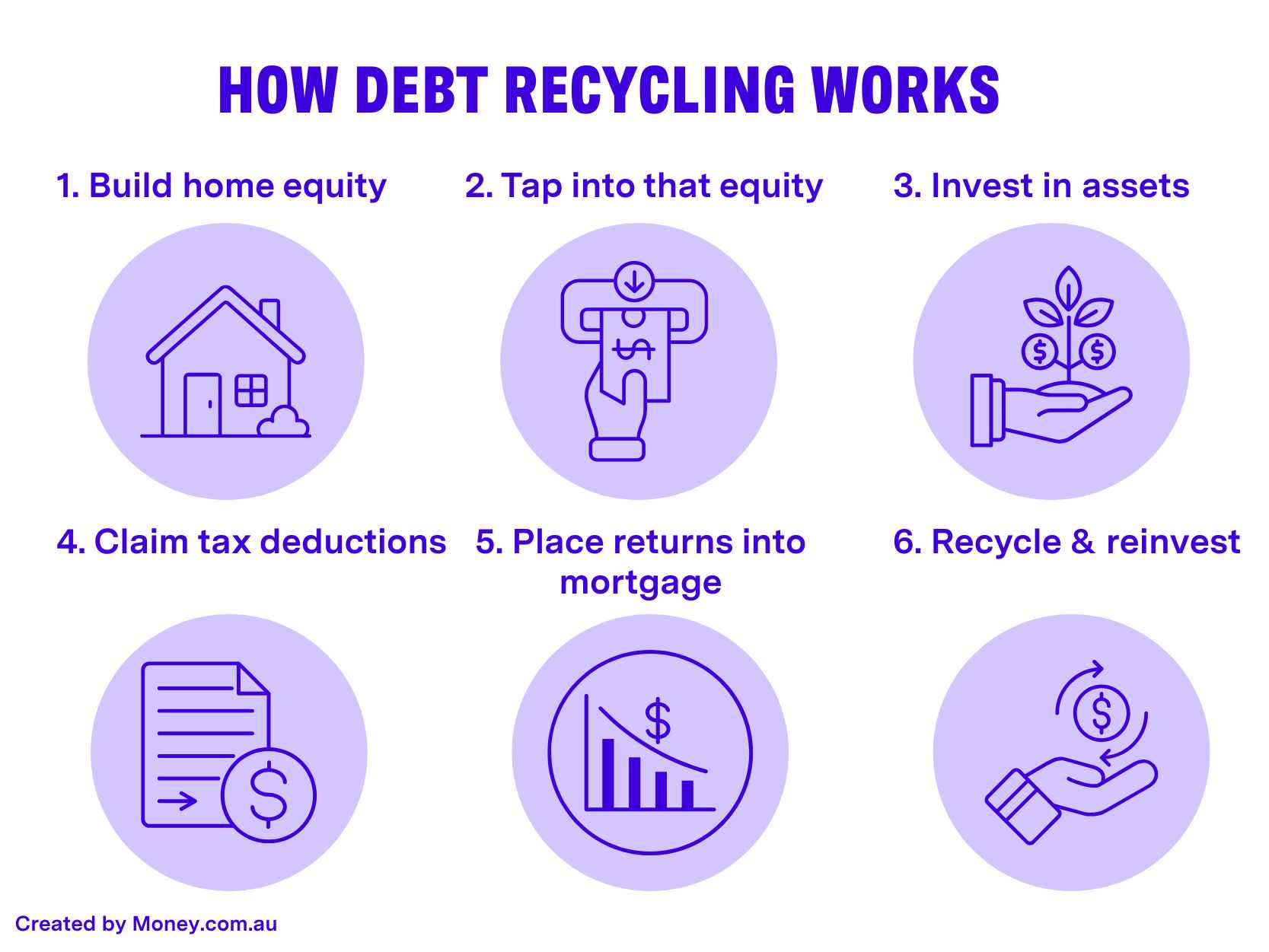
Here’s how debt recycling works on a principal place of residence with an existing home loan:
Build home equity
Make extra repayments into your home loan or place your savings in an offset account to reduce the amount of interest charged. More equity means a larger portion of your loan has already been paid down and is available to borrow for investing.
Access that equity
Once you’ve built enough equity, you can borrow against the amount you’ve paid into the home loan (by refinancing and restructuring the loan). This creates a separate investment interest-only loan component that is clearly earmarked for investment purposes.
Invest in other assets
Use the funds to invest in assets that have the potential to deliver returns, such as shares, ETFs, managed funds or an investment property. Seeking guidance from a financial advisor can help ensure your investment choices align with your goals.
Claim tax deductions
Because the borrowed money is used for investing rather than personal use, the interest on this portion of the loan is generally tax-deductible under Australian tax rules. This shifts part of your debt from non-deductible (home loan) to deductible (investment loan).
Place investment returns into loan
Income generated from your investments, together with tax savings from deductible interest, is put back into your home loan. This speeds up the repayment of the non-deductible portion of your mortgage.
Rinse and repeat
As your home loan balance falls and equity rises, you can redraw more funds to invest again. Over successive cycles, more of your total debt becomes tax-deductible while your investment portfolio grows alongside a faster-shrinking mortgage.

The average borrower who comes to Money.com.au looking to refinance an owner-occupier home loan has an LVR of around 51%, and has roughly $300,000 of equity built up in their property. In short, the average Aussie homeowner has more than enough equity to at least consider a debt recycling strategy.
Our latest survey also found that homeowners with a mortgage had an average savings balance of $38,691, giving them additional flexibility when exploring strategies like debt recycling.
Example of debt recycling
The Harrington family own a home valued at $1 million with a $600,000 owner-occupied mortgage. They also have $100,000 sitting in an offset account.
Rather than leaving this money in their offset, they pay the full $100,000 into their home loan as a lump sum, on top of their regular repayments. This permanently reduces their non-deductible home loan balance and lowers their monthly repayments from $3,685 to $3,070.
Once the loan balance is reduced, the Harringtons refinance and apply for a separate $100,000 investment loan split, with the help of a mortgage broker. This loan split isolates the borrowed funds so they are clearly separated from the owner-occupied loan.
They then use the $100,000 investment loan as the 20% deposit and to cover stamp duty on a $500,000 investment property. Because the borrowed funds are used for income-producing purposes, the interest on this loan split is generally tax deductible.
The remaining 80% of the property’s value is funded through a standard investment loan, which is also typically tax deductible.
As a result, the Harringtons have converted $100,000 of their original home loan from non-deductible debt into deductible investment debt, without increasing their total borrowings.
Any rental income and potential tax savings can then be used to further reduce their remaining home loan over time.

Nick Burgess, Senior Mortgage Broker at Money.com.au
“The idea is straightforward. If someone has $100,000 in savings, instead of investing that money directly, they first use it to pay down their home loan. They then re-borrow the same $100,000 through an investment loan and invest it. This turns part of their home loan into investment debt, which may be tax-deductible. It’s always best to speak with a tax professional and a mortgage broker to see if this financial strategy is right for you.”
Nick Burgess, Senior Mortgage Broker at Money.com.au
Benefits of debt recycling
- Helps convert non-deductible home loan debt into tax-deductible investment debt over time.
- Over the long term it reduces the total interest paid on your mortgage if investment income and tax savings are redirected to repayments.
- It allows you to build an investment portfolio using your home equity instead of using your cash savings directly.
- Interest on the investment portion of the loan may be tax-deductible, improving after-tax cash flow.
- Offers the potential to accelerate long-term wealth creation by combining investing with mortgage reduction.
- Uses existing home equity rather than requiring other funding, like a personal loan.
- Provides flexibility, as the strategy can be paused or scaled depending on your financial situation.
- It may improve long-term financial efficiency by prioritising the repayment of “bad” non-deductible debt first.

Debt recycling risks
- Investment returns are not guaranteed, and poor performance can leave you worse off while still carrying the debt.
- Market downturns can reduce the value of your investments even though loan repayments and interest continue.
- Interest rate increases and higher borrowing costs could reduce the effectiveness of the strategy.
- It increases overall exposure to debt, which may strain cash flow if your income drops or expenses rise.
- Selling investments at a loss to manage cash flow can lock in losses and undermine the strategy because you may be forced to sell assets for less than you paid, permanently reducing your investment portfolio and eroding the long-term benefits debt recycling relies on.
- Incorrect loan structuring or mixing personal and investment funds can jeopardise tax deductibility because if borrowed money isn’t used solely for investment purposes, it can become difficult to trace, potentially causing some or all of the interest to lose its tax-deductible status.
- The strategy requires discipline, as investment income and tax savings must be consistently redirected to the home loan.
- It may not be suitable for short timeframes, as debt recycling generally works best over the long term.

Debt recycling is complex and not suitable for everyone. Getting advice from a mortgage broker, financial adviser and tax professional can help ensure it’s set up and managed correctly.
Is debt recycling really worth it?
It can be – but it’s not for everyone. To start with, you’ll generally need to have a decent amount of equity in your home, a stable income, and a clear, long-term investment plan. You’ll also need to be comfortable with some level of risk, as investment values can move up and down in the short term.
It’s also worth asking yourself how you’d cope if something unexpected happened, like an illness, injury, or job loss. Would your savings or spouse’s income be enough to cover both your home loan and investment loan repayments? In these cases, taking out income protection insurance can help cover repayments if you’re unable to work for a period of time.
If your goal is to minimise “bad debt” and replace it with “good debt”, debt recycling can be a strategy worth exploring. Just be sure to seek guidance from a finance and tax professional as they will get to know your situation and property goals.

Options compared

Home loan types

Borrower types