




What is a common debt reducer?
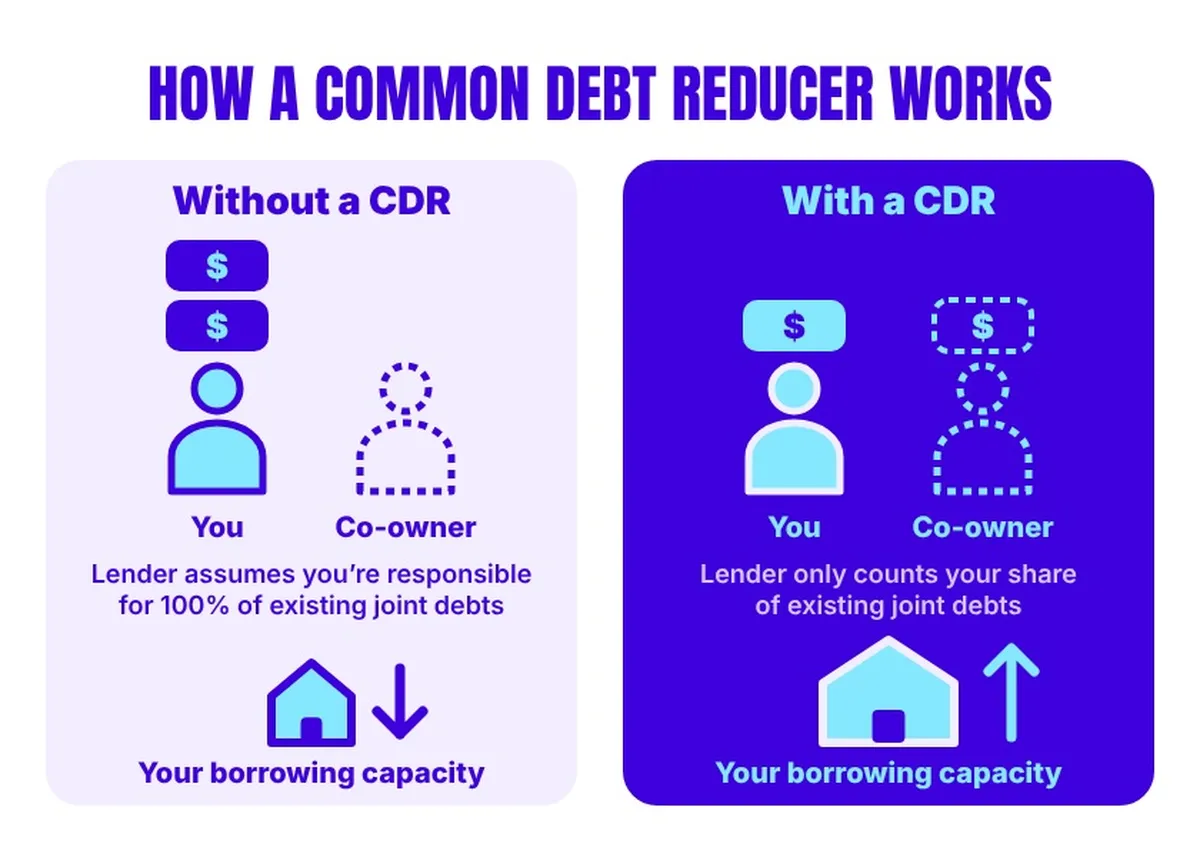
A common debt reducer (CDR) can be used to improve a loan applicant’s serviceability and borrowing capacity by more accurately reflecting their share of existing joint debts or expenses.
It’s commonly used as a way for lenders to assess customers who are looking to apply for a loan, but not with the person they already have an existing loan with.
So the applicant already shares a debt with someone else who's not going to be applying with them.
Without a common debt reducer, lenders would assess the loan application assuming the applicant is responsible for repaying 100% of a debt, even if in reality they split it 50/50 with another person.
How could a common debt reducer impact your loan?
Our analysis of an example borrower scenario shows that modelling a common debt reducer lifted median borrowing capacity by around 17%. That could be the difference between being approved for a loan or not.
Our example was based on a single home loan applicant with no dependants looking to borrow $500,000 to purchase a property valued at $750,000.
The applicant already co-owned an investment property with a former partner, who was not on the new application. The balance on the existing loan was $200,000, with repayments of around $1,300 per month and rental income of $300 per week ($1,300 monthly).
If, as happens by default, the lender assessing the new application assumed the applicant was responsible for 100% of the existing loan repayments, their median borrowing capacity among the lenders we assessed was around $546,000. In several of the lender calculations, capacity fell short of the $500,000 needed.
Were the lender to assess the applicant based on their commitment being 50% of the existing loan repayments instead of the full amount, the median borrowing capacity jumped to almost $637,000, with all lenders assessing borrowing capacity above the required loan amount.
That’s an extra $91,000 in borrowing capacity due to the CDR style assessment.
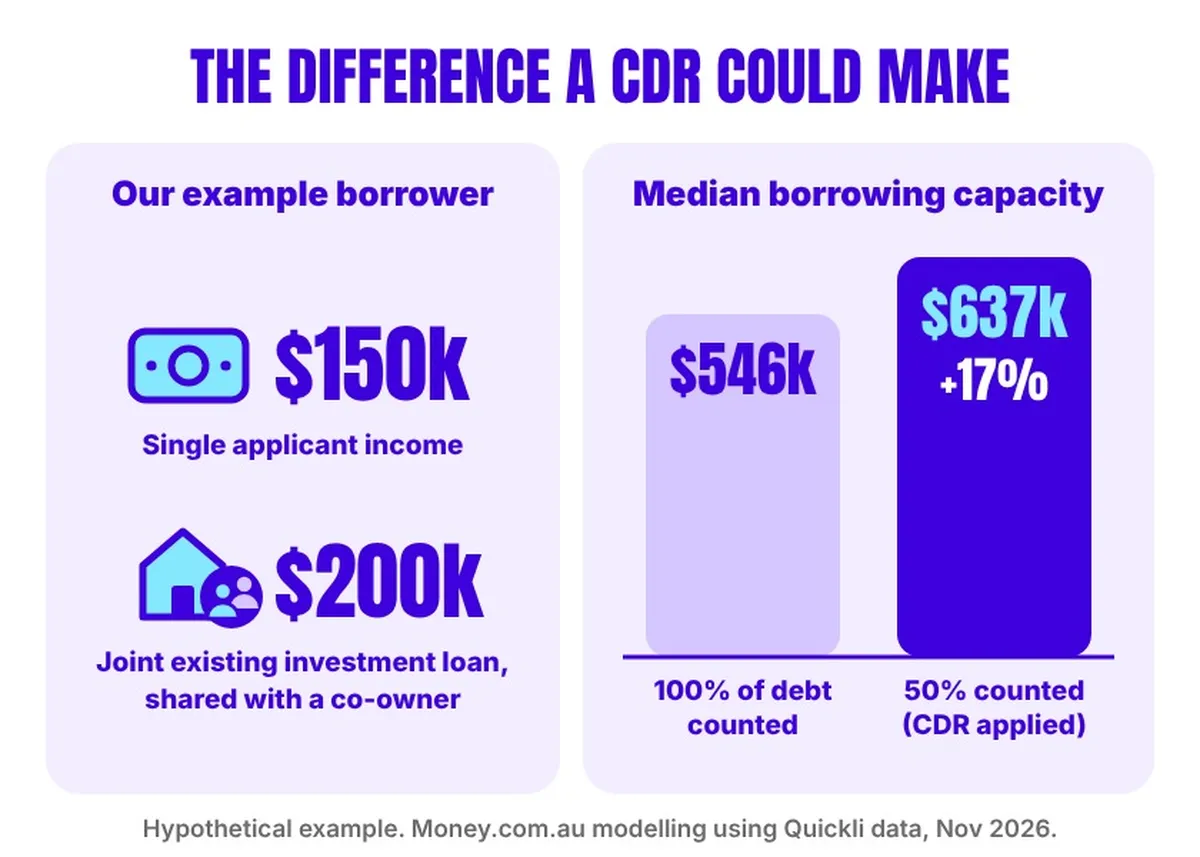
This is a hypothetical example only. Your borrowing capacity will depend on your circumstances and the lender’s assessment. Source: Money.com.au modelling across 23 lenders in November 2026. Both scenarios were modelled by adjusting the applicant’s share of the investment loan and rental income to replicate the effect of a common debt reducer. Specific CDR policies vary by lender and not all lenders will consider this approach.
When can a common debt reducer be applied?
There are two main scenarios when a common debt reducer may be applied.
Applying for a loan individually while already having joint debt
Some lenders will consider a CDR if you and a partner already have a joint loan on a property (e.g. your current residence), but you plan to purchase an investment property by yourself.
In that scenario the lender assessing the new one would use a common debt reducer to recognise only your share of the current repayments when assessing the application.
Applying for a loan individually while in a relationship
For some lenders a non-applicant partner, whether you're married or de facto, can be considered as a dependant, even if they have their own income and contribute to expenses.
They look at it similarly to having a child dependant, which in our experience can take roughly $50k off your borrowing capacity.
In this scenario, CDR could also come into play, meaning the lender would acknowledge the partner’s financial independence based on their income and contribution to shared household costs.
Typically when you've been in a relationship with someone for more than two years or you're living together, lenders will generally treat you as de facto if you live together as a couple.
Client case study: CDR policy in action
A client recently approached Money.com.au looking to increase their borrowing capacity. Both they and their partner had loans on their own separate properties, as well as a property they share.
The client now wanted to buy another property individually, but found that most lenders were assessing the situation based on them being responsible for 100% of the shared property expenses, on top of the cost of the other existing property they owned individually.
Lenders the client had spoken to were also categorising their de facto, financially-stable partner as a dependant. These factors combined were massively reducing the client’s borrowing capacity and prevented them from being able to progress with their property purchase.
As an alternative, our brokers were able to find a lender that would use a common debt reduction to more accurately assess the distribution of expenses. We simply needed to provide evidence of the client and their partner’s income, debts and existing home loan repayment amounts to demonstrate that the partner could contribute to their share of household costs.
Which lenders offer common debt reducers?
Below we’ve rounded up some examples of the lenders in Australia that offer CDR as a solution for borrowers.
| Lender | Policy | Key conditions |
|---|---|---|
AMP Bank | Common debt reducer | Divides debt and repayments between partners when assessing serviceability. Can apply to non-spousal investment property debts. Requires a signed statutory declaration verifying expenses and ownership contributions. |
MyState Bank | Common debt reducer | Limited to spouses living at the same address. Requires the non-applicant spouse's consent, identification and income documentation. Both the overall household and applicant must pass serviceability assessments. |
Macquarie Bank | Spousal debt reducer | Allows joint financial commitments with a non-applicant spouse to be apportioned in the serviceability assessment. The non-applicant spouse must demonstrate they can service the remaining debt. Requires an additional combined household serviceability assessment, income verification and written acknowledgement. Only applies to spousal/partner arrangements. |
GMCU | Apportionment of joint commitments | Allows a sole applicant's share of a jointly held liability to be used instead of the full repayment when assessing serviceability. The full liability is included initially. A reduction may be considered if there is evidence the other party meets their share and the other party provides their financial information and passes a serviceability assessment. |
St.George | Common debt reducer | Can be used to improve an applicant’s borrowing capacity when they have a joint debt with someone not party to the new loan. |
Pepper Money | Common debt reducer | May consider 50% of joint repayments when one spouse applies individually, subject to household affordability checks. |
MA Money | Common debt reducer | A common debt reducer may be considered on existing liabilities. Subject to privacy consent from the non-applicant party and evidence of income. |
Carefully consider if you really need a CDR to get approved

Nick Burgess, Senior Mortgage Broker
"Depending on your situation, choosing a lender based on its CDR policy could limit your options. If you’re able to do a straightforward home loan application without needing a common debt reducer to improve your borrowing capacity, then you’ll likely have access to a broader range of lenders and rates to choose from."
Nick Burgess, Senior Mortgage Broker
Common debt reducer eligibility requirements

Evidence of the non-applicant’s income
In most CDR cases, the lender will require proof that the applicant’s partner is earning enough income to cover their own share of costs. This could involve providing the non-applicant partner’s written or verbal consent, identification and income documentation.

Documentation of joint loans
The lender will ask for details about your other debts, including any loans that you share with someone else. It’s likely that when deciding to apply a CDR that the lender will require verified statements or a repayment history for the loan.

Calculations of household costs
Lenders will usually require an estimate of monthly household expenses to calculate the split in financial responsibilities between partners. This can include costs like subscriptions, shared loan repayments, and utility bills.

Investment properties only
Some lenders will specify that CDR can only be applied for an investment property loan, and not an owner-occupied property. In some circumstances, the lender may count rental income into their serviceability.