
Removing a guarantor from your home loan: How it works
Most lenders will consider releasing your guarantor once your loan-to-value ratio (LVR) is 80% or less. At that point, the lender no longer needs your guarantor’s property as extra security for the loan, and you can avoid lender’s mortgage insurance (LMI).
Your LVR is your loan balance divided by your property’s value. It falls as you pay down your loan, your property grows in value or, ideally, both. But one aspect of the calculation catches out a lot of the borrowers we speak to:
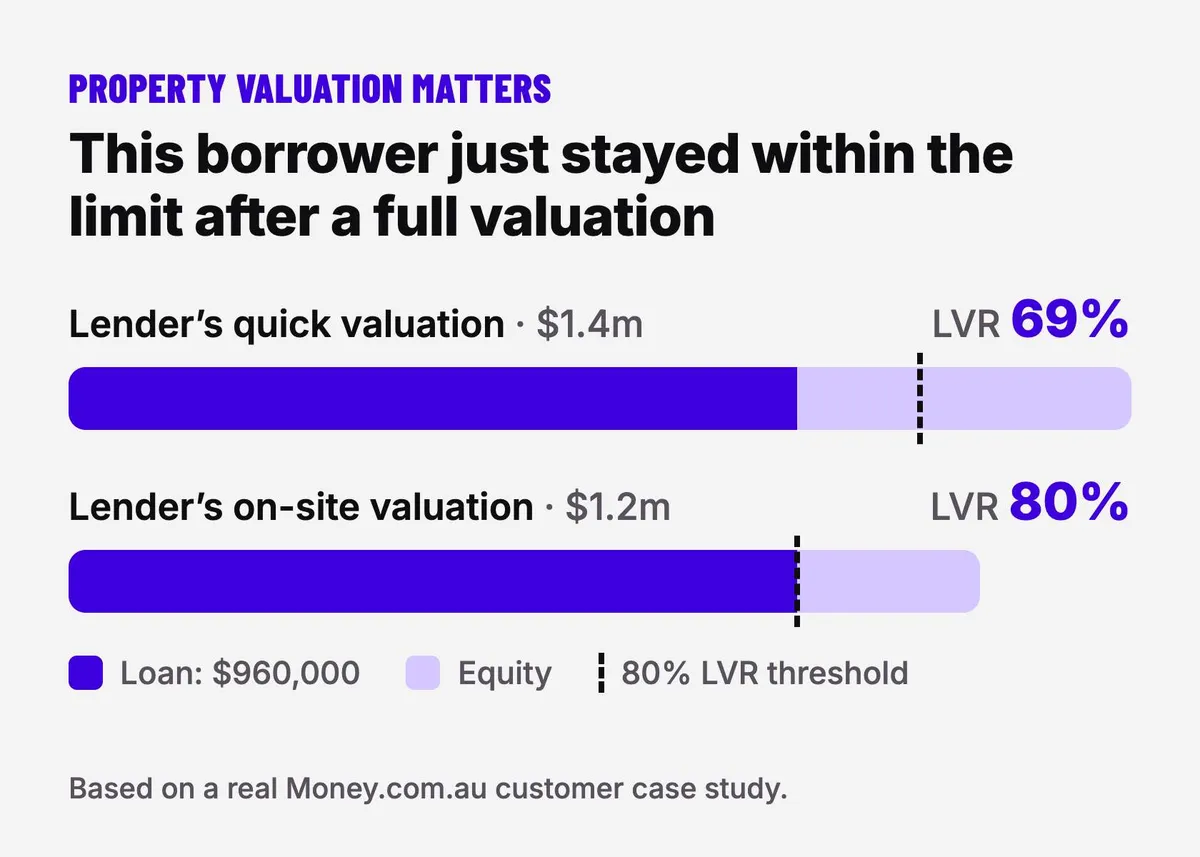
It’s the lender’s valuation of the property that matters, not what you think it's worth or what it says on a property website. Online estimates will give you an idea of where your LVR sits, but the lender uses its own valuation when assessing the loan.
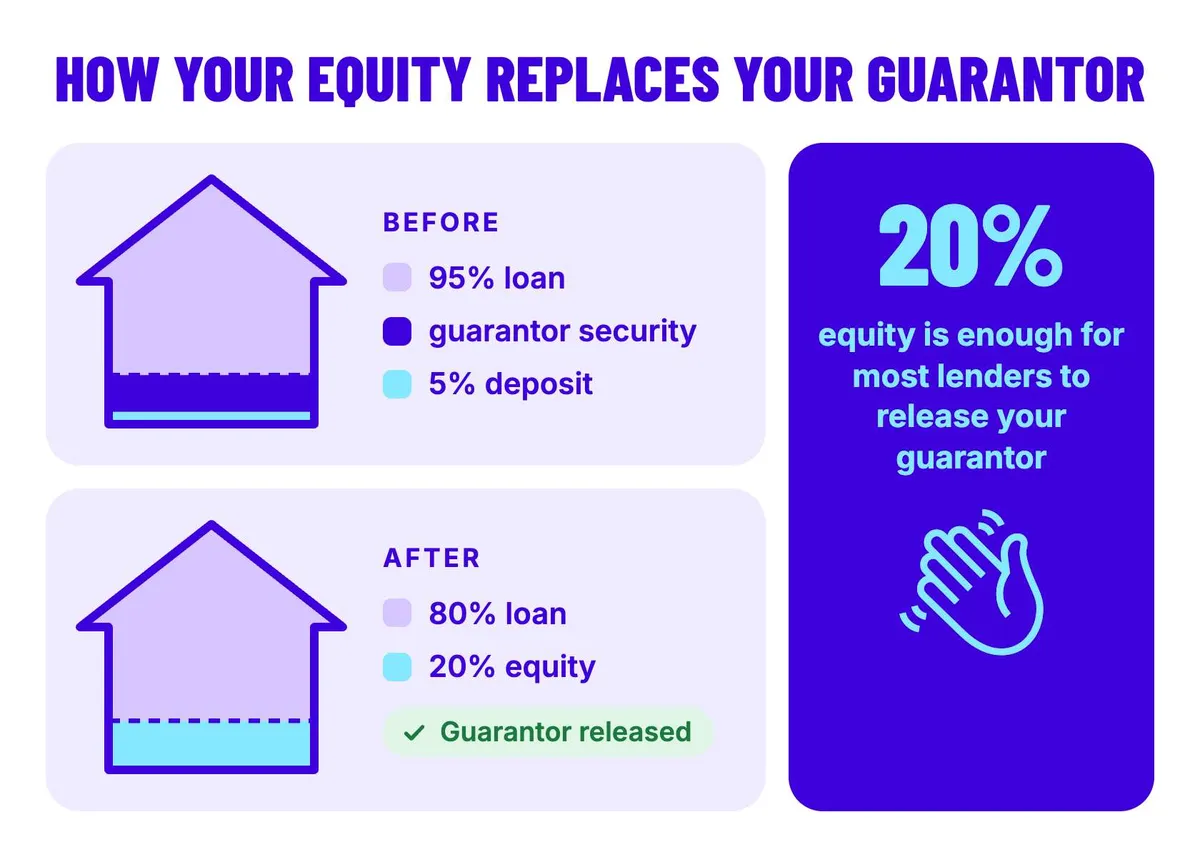
Guarantor release doesn’t happen automatically
Your guarantor home loan won’t automatically be updated to remove the additional security once your LVR reaches 80%.
You’ll need to apply to have your guarantor removed and the lender will need to approve the change. Generally, you’ll need to meet these additional conditions:
- Your repayment history will need to be up to date, with no arrears.
- You’ll need to demonstrate that you can afford the loan on your own. Expect a reassessment of your income, expenses and debts, even if you’re staying with the same lender. This matters most if your guarantor’s income helped you qualify for the loan in the first place, not just their property.

Using the same lender vs refinancing
There are two ways to remove a guarantor from your mortgage: Release with your current lender or handle it as part of a refinance to a new lender. Either way, the lender will order a valuation and reassess your finances, so it’s worth comparing both before you decide.
| Stay with your lender | Refinance to a new lender | |
|---|---|---|
Speed | Usually faster, since it’s handled internally | Takes longer, with a new application and settlement |
Costs | Possible release or discharge fees | Discharge fee from your old lender, government registration fees and possibly application fees |
Valuation | Some lenders charge for it | Many lenders cover it |
Assessment | Full reassessment of your finances | New application and credit enquiry |
Rate | A chance to ask for a better rate | Access to the whole market |
Refinancing to remove a guarantor is a chance to review your loan

Nick Burgess, Senior Mortgage Broker
“When you remove a guarantor, the lender is reassessing your loan anyway, so it’s a good time to tidy up the structure and look at the overall deal you’re on. If your loan was split to separate the guaranteed portion, you can usually merge the splits into one loan, so you’ve only got one set of repayments to manage. It’s also worth checking you’re on the best home loan rate you can get and not overpaying for loan features you’re not using.”
Nick Burgess, Senior Mortgage Broker
How to remove a guarantor step by step
Check where your LVR sits
Use our LVR calculator with your loan balance and an estimate of your property’s value. If you’re close to 80%, leave yourself a buffer.
Compare staying with switching
Ask your lender what it charges to release the guarantee and what rate it can offer, and compare that with other lenders. A broker can do both at once.
Gather your documents
Expect to provide ID, recent payslips, bank statements and your current loan statement, as the lender will reassess your finances.
Get the valuation
The lender will order a valuation to confirm your LVR. Check upfront whether you’ll be charged for it.
Get your guarantor to sign the release
Your guarantor will generally just need to sign a form agreeing to the release. If you’re switching lenders, or your lender is CommBank or NAB, a discharge authority signed by the borrowers (and, with CommBank, the guarantors) will also be needed.
Sign your new loan documents
Once the loan is approved, you’ll sign the new loan documents. You may also need to show your building insurance lists the lender as an interested party.
Get written confirmation
The release isn’t complete until settlement, when the lender confirms it in writing and the mortgage over your guarantor’s property is removed from their title.

How long does it take? In our experience, if you stay with your current lender, it can take as little as one to two weeks. Switching lenders usually takes longer, as it involves a new application and settlement with a different lender, but it can still happen within a few weeks if the stars align.
Two borrowers, two different approaches to removing their guarantor

Yang Qiu, Money.com.au Senior Mortgage Broker
One of Money.com.au's mortgage brokers, Yang Qiu, explains how two of his clients went through the process of releasing their guarantors in different ways.
Case study 1: Removing guarantor with existing lender
“I had a client whose parents had guaranteed a 20% split on his loan with St.George. He came to us wanting to get them off the loan, and he was hoping to find a lower rate while he was at it.
I shopped around, but St.George’s offer came in close enough to the best alternatives that switching just wasn’t worth the extra refinance costs. So we facilitated an internal refinance.
His parents signed a discharge form, we merged his two splits into one loan, and he ended up about 18 basis points lower than his previous rate. It was approved nine days after we first spoke, and settled the following week.”
Case study 2: Refinancing externally to save on fees
“Another client had his parents as guarantors on a loan with a smaller customer-owned lender. When he asked about having them released, the lender was going to charge a $1,000 fee to value his property. Because he lived out in a rural area, a cheaper desktop valuation wasn’t an option.
So I looked at lenders that cover the valuation themselves. Switching would cost him around $700 in discharge and government fees, for a rate about the same as what he was already paying.
The move also gave us the chance to merge his two splits and look at rolling a personal loan into the mortgage while staying under 80% LVR. I lined up a backup lender too, just in case the valuation came in short.”
Yang Qiu, Money.com.au Senior Mortgage Broker
How different lenders handle guarantor release
We reviewed the guarantor policies of Australia’s biggest banks and a range of other popular lenders. Here’s how a selection of them handle guarantor release. Most take one of three approaches:
- Release once you’re under 80% LVR: The likes of Westpac, St George and IMB will consider releasing your guarantor once your loan is below 80% of your property’s value, based on a new valuation.
- Pay off the guaranteed loan: Lenders including CommBank, Bankwest and Newcastle Permanent set up the guaranteed portion as a smaller separate loan. Once that’s paid off, you can apply to have your guarantor released.
- Reassess the loan in full: Macquarie and NAB treat release as a change to the loan that requires a full credit assessment of the remaining borrowers.
Lender | Westpac |
|---|---|
When it’ll consider release | Below 80% LVR, so lender's mortgage insurance (LMI) isn’t required |
What’s involved | New full valuation, loan payments up to date, and the remaining balance must meet Westpac’s credit criteria |
Lender | St George |
When it’ll consider release | Once you’ve built enough equity in your property |
What’s involved | Same Family Security Guarantee policy as Westpac |
Lender | IMB Bank |
When it’ll consider release | Loan balance below 80% of the property’s market value |
What’s involved | Valuation by an IMB panel valuer, and approval is at IMB’s discretion. The guarantor can also end the guarantee by paying the guaranteed amount |
Lender | CommBank |
When it’ll consider release | When the bank no longer needs the guarantee, for example once the guaranteed amount is paid off |
What’s involved | Discharge Authority signed by all borrowers and guarantors |
Lender | Bankwest |
When it’ll consider release | Once the separate guaranteed loan is paid off in full |
What’s involved | Apply to remove the guarantee |
Lender | Newcastle Permanent |
When it’ll consider release | Once there’s enough equity to pay out the guaranteed loan |
What’s involved | Guaranteed portion set up as a separate loan, which is paid out to release the guarantor |
Lender | NAB |
When it’ll consider release | Once you can take on the loan on your own, for example after building equity |
What’s involved | Internal refinance and a Mortgage Discharge Authority. NAB no longer offers new family guarantees through brokers |
Lender | Macquarie |
When it’ll consider release | On application |
What’s involved | Full credit assessment, Home Loan Variation Application and an email explaining the request. Apply directly or through a broker |
| Lender | When it’ll consider release | What’s involved |
|---|---|---|
Westpac | Below 80% LVR, so lender's mortgage insurance (LMI) isn’t required | New full valuation, loan payments up to date, and the remaining balance must meet Westpac’s credit criteria |
St George | Once you’ve built enough equity in your property | Same Family Security Guarantee policy as Westpac |
IMB Bank | Loan balance below 80% of the property’s market value | Valuation by an IMB panel valuer, and approval is at IMB’s discretion. The guarantor can also end the guarantee by paying the guaranteed amount |
CommBank | When the bank no longer needs the guarantee, for example once the guaranteed amount is paid off | Discharge Authority signed by all borrowers and guarantors |
Bankwest | Once the separate guaranteed loan is paid off in full | Apply to remove the guarantee |
Newcastle Permanent | Once there’s enough equity to pay out the guaranteed loan | Guaranteed portion set up as a separate loan, which is paid out to release the guarantor |
NAB | Once you can take on the loan on your own, for example after building equity | Internal refinance and a Mortgage Discharge Authority. NAB no longer offers new family guarantees through brokers |
Macquarie | On application | Full credit assessment, Home Loan Variation Application and an email explaining the request. Apply directly or through a broker |
Why the valuation can make or break your guarantor release
Lenders often start with a quick, computer-generated valuation, but may order an on-site valuation before approving the release. The on-site valuation sometimes yields a different result and this is what the lender uses.
For the borrower in our first case study, the gap was $200,000, enough to take his LVR from 69% to 80%. His parents were still released as guarantors, but he got a smaller rate cut than he was first quoted.
Quick valuations also aren’t always possible for rural properties. That’s why the borrower in our second case study was asked to pay $1,000 for an on-site valuation. Many lenders cover this cost, so ask before you go ahead.
What does it cost to remove a guarantor?
The cost of removing a guarantor from your home loan depends on whether you stay with your lender or switch. But there will likely be fees either way.
As a rough guide, if you stay with your current lender and it covers the valuation, you might pay around $500 to $750 in fees. That can rise to around $1,750 if you have to pay for a full valuation yourself. If you refinance to a new lender, expect to pay around $600 to $2,000, depending on whether it charges application and settlement fees.
Below we show the main costs to budget for. You can usually choose to pay these upfront or add them to your loan. If you’re close to 80% LVR, adding them could push you over the line, so check with your broker first.
- Valuation fee: Many lenders cover it, but some charge, and a valuation can cost anywhere between $50 and $1,000 depending on the lender and property location.
- Release or discharge fee: Charged by your lender to release the guarantee over your guarantor’s property, typically between $350 and $500.
- Government fees: To register the release of the mortgage on your guarantor’s title, and on yours if you switch lenders. Ranges from around $130 to $250 depending on the State/Territory you live in.
- Application/establishment fees: If you decide to switch to a new lender. It's only charged on some loans and when it is, it usually costs between $150 and $750.
- Settlement fee: Again, usually only charged if you switch lenders and is typically between $200 and $300. Some lenders waive this fee for new customers.
- Lender's mortgage insurance (LMI): May apply, but only if your lender agrees to release your guarantor while your LVR is above 80%.
What if you’re not ready to release your guarantor yet?
If your LVR is still above 80%, your guarantor may not be released yet, but there are a few ways to get there sooner.
- Make extra repayments: Extra repayments or a lump sum reduce your balance and your LVR. If your loan is split, putting them toward the guaranteed split can get your guarantor released sooner. Money in an offset account may not count toward your LVR, so check with your lender.
- Pay LMI: Some lenders will release your guarantor above 80% LVR if you pay lender's mortgage insurance. It costs more, but it can make sense if your guarantor needs their property freed up, for example to sell or borrow against it.
- Ask about reducing the guarantee: Some lenders may agree to lower the amount your guarantor is liable for, even if they can’t release them completely.
Can your guarantor be removed before you reach 80% LVR?
If your guarantor needs their property freed up sooner, for example to sell, downsize or borrow against it, they may have a few options, depending on the lender:
- Pay out the guarantee: Some lenders, such as IMB, let the guarantor end the guarantee by paying the guaranteed amount.
- Swap their property for cash security: If your guarantor sells their home, the lender may agree to hold part of the sale proceeds, often in a term deposit, as security instead of their property until your LVR is low enough.
Both of these need the lender’s approval, so your guarantor should talk to the lender, and get independent legal advice, before committing to a sale or new loan.
Does removing a guarantor affect my credit file?
If you refinance to a new lender, the application will show as a credit enquiry on your file. Staying with your current lender may involve a new application too.
A mortgage broker can assess your eligibility before you apply, so you don’t add an enquiry to your file for an application that’s unlikely to be approved.