Money

Should You Extend Your Mortgage Term?

  • Extending your home loan term lowers your repayments, but you’ll pay more interest in the long term.

  • Our experts can help you understand the implications and whether it makes sense for you.

Looking to lower your repayments?

Add your loan amount and property value to see your LVR
Michael Burgess
Katey Russo Money.com.au Mortgage Broker
Nick Burgess - Money.com.au Mortgage Broker
Refinance with support from our trusted team of home loan experts. Updated 16 Nov 2026.

Extending your mortgage term

Key things to know

file-check

Can I extend my home loan?

Usually, yes, either by asking your current lender or by choosing a longer term when you refinance. Most lenders cap a loan at 30 years, though a few offer up to 40, subject to age caps.

Currency dollar circle icon

What difference could it make?

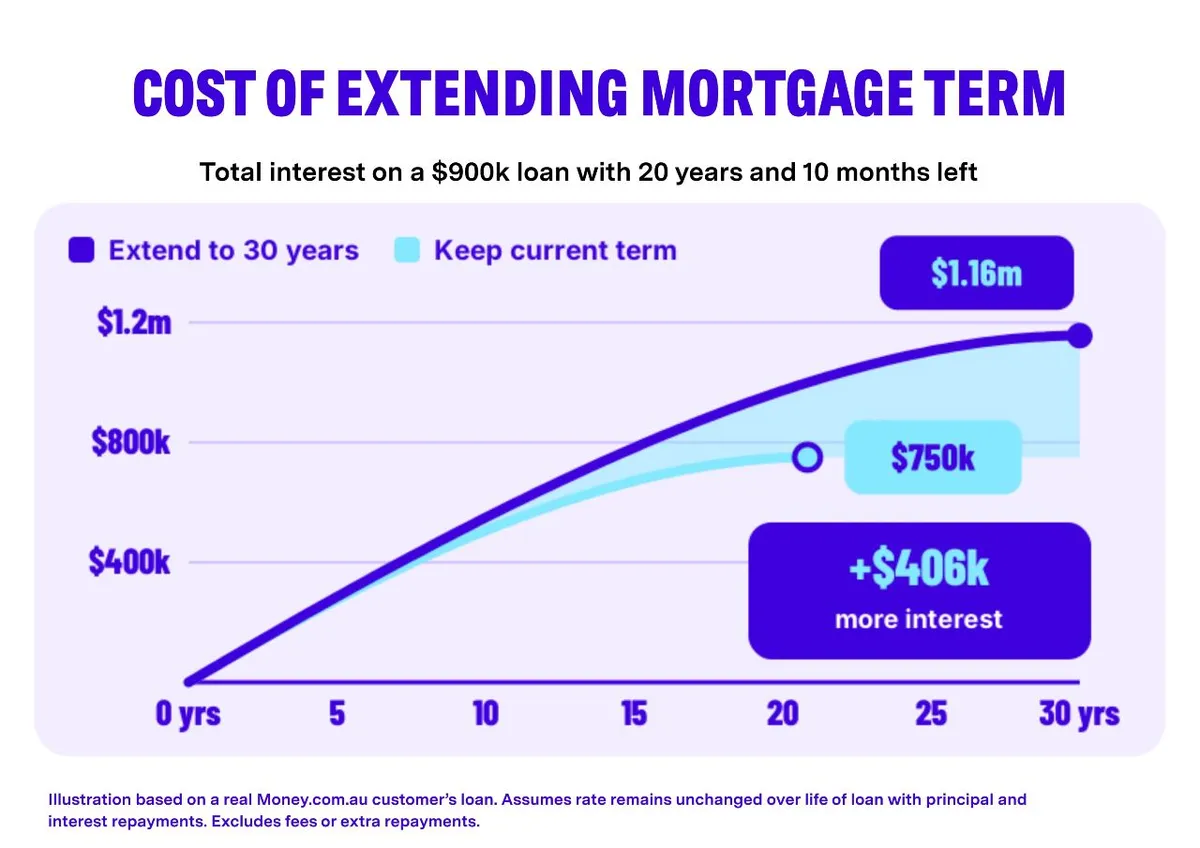
For one Money.com.au customer with a $900k loan and around 21 years left, reverting back to 30 years would have cut their repayments by about $900 a month, but added close to $400k in interest.

Avatar of Nick Burgess

“If you want lower repayments, extending your loan term shouldn’t be the first option you look at. A better rate also lowers your repayments, without the long-term cost."

Nick Burgess

Senior Mortgage Broker at Money.com.au

Two ways to extend your mortgage term: Current lender vs refinance

You can extend the term on your home loan either by requesting a variation on your existing loans with your current lender, or by refinancing to a new lender and setting a longer term as part of the process.

Doing it with your current lender will likely be quicker, but looking elsewhere is often beneficial as you may be able to secure a better home loan rate while you’re at it.

Here’s how each option works:

How it works

Ask your current lender

You apply to vary your term on your existing loan

Refinance to a new lender

You take out a new loan and choose the term at application

Assessment

Ask your current lender

Policies vary. Some lenders allow an extension within a 30-year total, while others need a full credit assessment or rarely approve one

Refinance to a new lender

A full application, including a servicing check, unless you qualify for a streamlined refinance

Better rate

Ask your current lender

You can ask for a rate review at the same time, but you’re limited to your lender’s offer

Refinance to a new lender

You can compare rates across lenders

Costs

Ask your current lender

Usually fewer costs than switching

Refinance to a new lender

Refinance costs, including discharge, application, valuation and registration fees

Best for

Ask your current lender

You’re happy with your lender and want a simple change

Refinance to a new lender

A better rate is available elsewhere, or your lender won’t extend

Ask your current lender Refinance to a new lender

How it works

You apply to vary your term on your existing loan

You take out a new loan and choose the term at application

Assessment

Policies vary. Some lenders allow an extension within a 30-year total, while others need a full credit assessment or rarely approve one

A full application, including a servicing check, unless you qualify for a streamlined refinance

Better rate

You can ask for a rate review at the same time, but you’re limited to your lender’s offer

You can compare rates across lenders

Costs

Usually fewer costs than switching

Refinance costs, including discharge, application, valuation and registration fees

Best for

You’re happy with your lender and want a simple change

A better rate is available elsewhere, or your lender won’t extend

Should you do it? Pros and cons of a longer loan term

Pros

  • Lower repayments: Frees up cash each month if your budget is tight.
  • A safety net: You can keep paying your current amount and drop to the lower minimum if you need to.
  • Higher borrowing capacity: Lower repayments can increase how much a lender will let you borrow, which helps if you’re topping up your loan or buying another property.

Cons

  • More interest: going back to 30 years can add hundreds of thousands to your total interest.
  • Less equity: You pay down your loan more slowly, so you’ll have less equity if you sell, refinance or want to borrow against your home.
  • Debt later in life: Your loan could run into retirement, and age limits may restrict the term you can get.

How much will a longer term save and cost you?

To give you an idea of the impact of extending your loan term, here’s how the numbers looked for a recent Money.com.au customer refinancing a $900,000 loan with 20 years and 10 months left.

Monthly repayment

Current loan

$6,601

Extend to 30 years

$5,712

0.50% lower rate and extend loan to 30 years

$5,419

0.50% lower rate with existing loan term

$6,336

Change per month

Current loan

n/a

Extend to 30 years

-$889

0.50% lower rate and extend loan to 30 years

-$1,182

0.50% lower rate with existing loan term

-$265

Total interest

Current loan

$750,334

Extend to 30 years

$1,156,431

0.50% lower rate and extend loan to 30 years

$1,050,884

0.50% lower rate with existing loan term

$683,972

Current loan Extend to 30 years 0.50% lower rate and extend loan to 30 years 0.50% lower rate with existing loan term

Monthly repayment

$6,601

$5,712

$5,419

$6,336

Change per month

n/a

-$889

-$1,182

-$265

Total interest

$750,334

$1,156,431

$1,050,884

$683,972

Line chart comparing total interest paid on a $900k home loan with 20 years and 10 months left. Keeping the current term costs $750k in interest, while extending to 30 years costs $1.16m, or $406k more.

Keep your current repayment if you can

Nick Burgess, Mortgage Broker at Money.com.au

Nick Burgess, Senior Mortgage Broker

"Extending your loan term reduces your minimum repayment, but if your loan and budget allows it, consider paying extra to maintain your existing repayment level. This way you’ll stay on track to repay the loan within the existing term, but you’ll have the flexibility to lower the repayment in the future if you need to for any reason.”

Nick Burgess, Senior Mortgage Broker

What’s the maximum loan term you can extend to?

You can choose any term between what you have left and your lender’s maximum, so you don’t have to go all the way to 30 years. Adding just a few years may be enough to bring your repayments to a level you can manage, with less extra interest than a full reset.

Most lenders cap a home loan at 30 years. A few, mostly non-banks such as Granite, WLTH, Liberty, Pepper and Bluestone, offer up to 40-year mortgages on a refinance, but usually with conditions such as age limits or a higher rate.

For older borrowers, age is often the real limit. Most lenders want an exit strategy from age 50 or 55, which is your plan to repay the loan once your income drops, such as downsizing or using super. Some also set a maximum age by which your loan must be paid off:

  • Loan must end by age 80: Bank of Sydney (owner-occupied loans)
  • Loan must end by age 85: Granite, Zeus, WLTH and OwnHome
  • Loan must end by age 90: Firstmac and Apollo
  • Loan must end by your retirement age, unless you have an acceptable exit strategy: Westpac, St.George and Bankwest (Bankwest uses age 67 if that comes first)


Frequently asked questions

Yes, whether you ask your current lender or refinance, the lender will check that you can still afford the loan at a higher rate than you’re paying, and that the new term fits its age limits.

This can catch out borrowers whose repayments have become harder to manage, even if they’ve never missed one.

If you don’t pass the servicing test, some lenders, including NAB, Westpac and St.George, have refinance options with a lighter assessment for borrowers with a good repayment history.

A mortgage broker can tell you whether you’re likely to qualify. If you’re already struggling with repayments, ask your current lender about hardship assistance.

If you have a fixed rate loan, you usually can’t extend your current fixed period at the same rate. When it ends, you can re-fix for a new period at the current rates your lender is offering.

Many lenders will let you arrange this in the weeks before your fixed rate expires, so you can lock in a rate before the loan reverts to variable. You can also refinance to a fixed rate with another lender.

If you want to re-fix before your current period ends, you may have to pay break costs. Find out more about your options when your fixed rate ends.

Sometimes, but it’s treated as a new request, and the lender will reassess whether you can afford the loan. Most lenders cap how long a loan can be interest-only, and some limit it further depending on your loan term. WLTH, for example, allows up to five years interest-only on terms of 30 years or less, and up to 10 years on longer terms.

You don’t necessarily need to change your contract to finish your loan term, sooner. On most variable loans home loans, you can make extra repayments and pay the loan off ahead of schedule while keeping the lower minimum repayment as a fallback.

Formally reducing your term is a separate request to your lender, and it will increase your minimum repayment. Fixed rate loans usually limit how much extra you can pay each year.

Sean Callery is the Editor of Money.com.au. He has over 15 years of international experience in journalism and personal finance. He holds a Diploma of Finance and Mortgage Broking Management (FNS50322) and is compliant to provide general advice in Tier 1 General Insurance (RG 146) products.
Nick Burgess is an experienced Senior Mortgage Broker at Money.com.au. Whether he's negotiating directly with lenders or walking a first home buyer through the process step by step, Nick's goal is always the same — clear, practical guidance that leads to confident decisions.

Important Disclosures

^Comparison rate warning

Home loan comparison rates are calculated based on a loan amount of $150,000 repaid over a 25-year term with monthly repayments. The comparison rates only apply to the examples given. Different loan amounts and terms will result in different comparison rates. Costs such as redraw fees or early repayment fees and cost savings such as fee waivers are not included in the comparison rate but may influence the cost of the loan. Check with the provider for full loan details, including rates, fees, eligibility and terms and conditions to make sure the product is right for you.

General information only The information on this page is general in nature and has been prepared without considering your objectives, financial situation or needs. You should consider whether the information provided and the nature of any home loan product is suitable for you and seek independent financial advice if necessary.

We are not providing you with a recommendation or suggestion about a particular home loan. You should read the relevant disclosure statements or other offer documents before deciding whether to apply for or continue to use a particular product.

What products, features and information are shown We show product information from the providers in our lending panel and do not include all lenders in the market. Our product comparisons may not compare all home loan features and attributes relevant to you.

Product information, such as interest rates, fees and charges, is subject to change without notice. Before acting on any information, you should confirm the relevant product information with the lender.

How home loans are sorted and filtered by default When results load initially in our home loan comparison tables, we show relevant loans from our sponsored partners first, then all loans on our lender panel that are available based on the table's default loan settings. By default, products are sorted as follows:

  • Lowest regular repayment amount, then;
  • Loans interest rate, then;
  • Lowest comparison rate, then;
  • Provider name (A-Z)

Home loan products listed in our tables are available through a mortgage broker. Mortgage brokers cannot offer loans from every provider and there may be more suitable loans for your personal circumstances.

Mortgage brokers are not authorised by Money Pty Ltd's Australian Credit Licence and operate under their own Australian Credit Licence, or as a credit representative of another Australian Credit Licensee. Mortgage brokers can make recommendations about home loan products that may suit your objectives, financial situation and needs.

Partner lenders with loans marked as ‘sponsored’ may pay a commission to Money.com.au if you click to visit their website.

If you get help from a mortgage broker as a result of visiting this page, we may earn a commission. Learn more about how we make money.