
What is a home loan exit strategy?
A home loan exit strategy is your plan for repaying the loan if the term will run past your retirement age.
Most new home loans have a 30-year term and some lenders now offer 40-year mortgages. It’s also common for borrowers who already have a loan to extend their term when they refinance.
It means a borrower currently in their 40s or 50s could easily end up with a loan term that outlasts their working life.
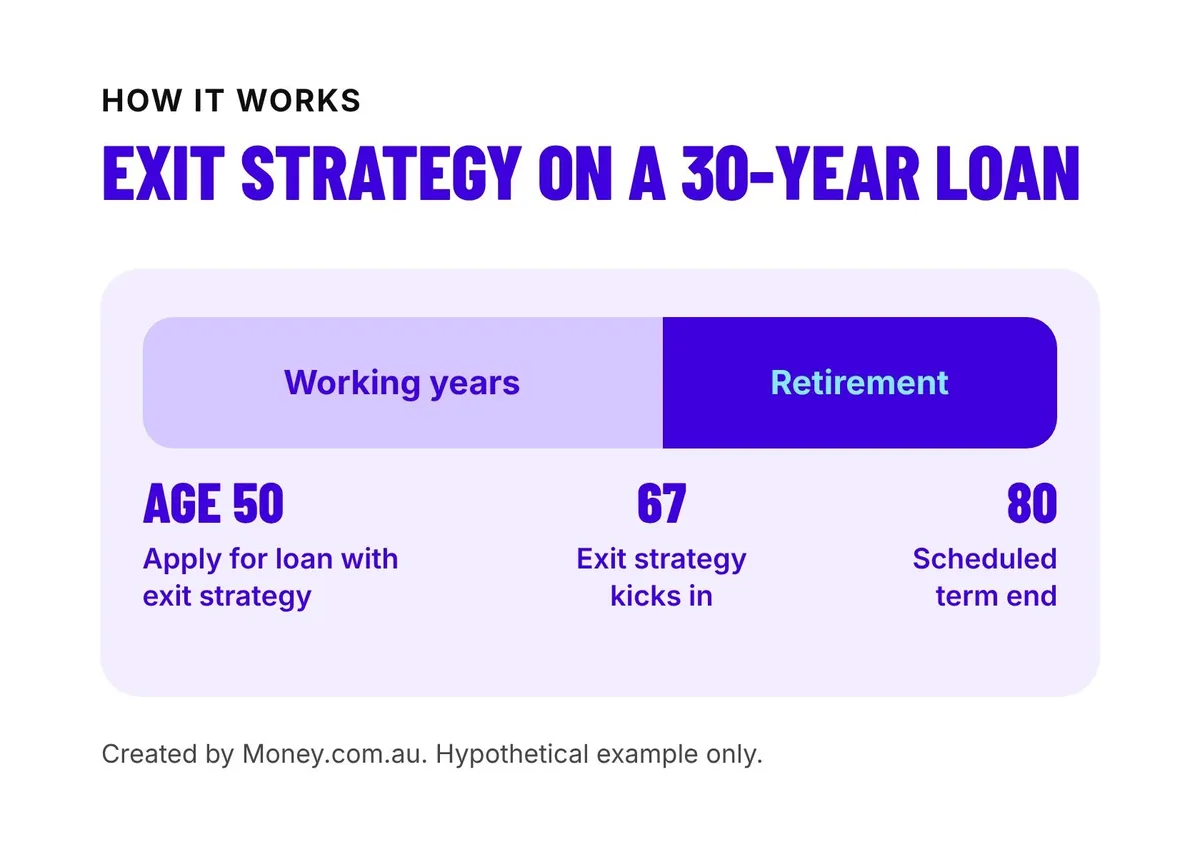
Say, for example, you’re 50 and take out a 30-year loan, but plan to retire at 67. That leaves 13 years of repayments with no wage coming in. Before approving the loan, the lender will want to know how you’ll cover that gap.
That’s what your exit strategy is for.
Your home loan exit strategy options
Each option explained
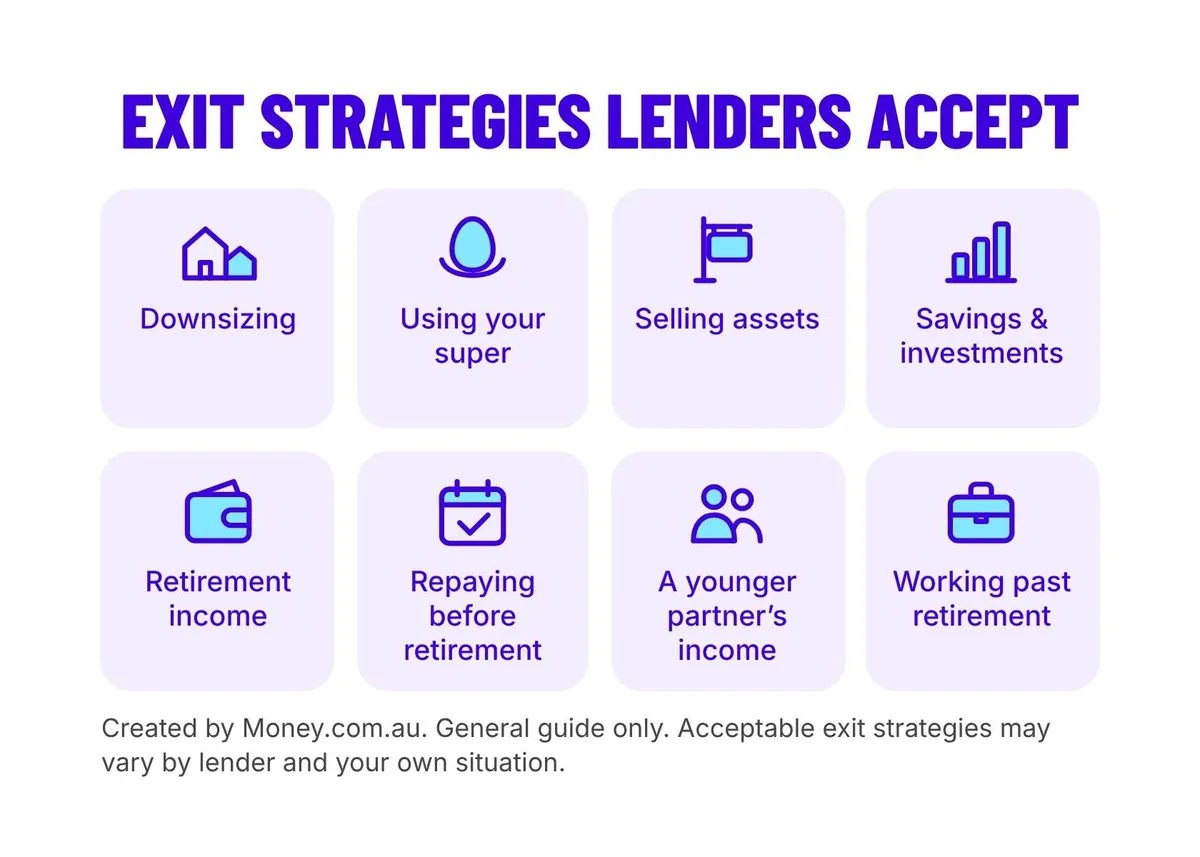
Downsizing
Selling your home and buying a smaller property is one of the most common exit strategies. The main condition is the sale needs to clear the loan and leave enough to buy your next place outright.
Under the National Consumer Credit Protection Act, if selling your home would be the only way to repay a loan, the loan is generally viewed as causing substantial hardship. That’s why lenders want to see you’ll still have somewhere to live, mortgage-free, after you downsize.
For example, NAB requires at least $200,000 in equity if your retirement is near (i.e. your current property's value minus your loan amount), and UBank requires at least $300,000.
If this is your strategy, expect to be asked where you’d move, what type of property you’d buy, the expected sale price and your timing.
Using your super
A lump sum from super can be used to clear the loan, but lenders also want to know you’ll have enough left to retire on.
Say you have $1 million in super but expect to owe $850,000 on your home loan at retirement. The remaining $150,000 probably won’t satisfy a lender. But if your loan balance is $150,000, your super would be a much more realistic plan.
There are limits, though. For example, Bendigo only accepts a lump sum if you’ll retire within 12 months, and won’t count future super contributions.
Selling assets or using savings
With this strategy you'd be using your cash savings, or funds generated from the sale of an investment property, shares or other investments. You'll need to factor in selling costs when assessing whether any investments will be sufficient to clear your home loan balance.
In terms of lender rules, Westpac and St.George only count assets owned by the applicants. If your retirement is near, NAB wants verified assets worth at least 100% of the loan limit.
Retirement income
Lenders may accept ongoing income from a super pension, rent, dividends, term deposits or annuities if it covers the repayments after you stop working.
Repaying the loan before you retire
Making extra repayments or choosing a shorter term can mean clearing the loan by retirement, but the higher repayments need to be affordable now.
A younger partner’s income
If you're applying with a partner who is younger and will keep working, their income may be sufficient to cover the repayments after you retire.
Working past retirement age
Some lenders will accept a plan that involves you continuing to work past retirement age, if that’s realistic given your profession and health.

What doesn’t count?
Lenders generally won’t accept plans based on money you don’t have yet as part of an exit strategy. That includes future inheritances, expected pay rises or bonuses, projected super balances, a pending legal settlement, the future sale of a business, or refinancing down the track.
When you’ll need an exit strategy (lender by lender)
Most lenders look at two things: your age when you apply, and your age when the loan is scheduled to end. At Bendigo Bank, for example, a 52-year-old taking out a 30-year loan would need an exit strategy, while the same borrower refinancing with 15 years remaining wouldn’t.
| Lender | You’ll need an exit strategy if... |
|---|---|
AFG Retro | You’re over 50 |
AMP | You’re 40 or older and the loan ends after 70 or your planned retirement, whichever comes first |
Apollo | Any applicant will be 70 or older when the loan ends |
Auswide | You’re 55 or older and the loan ends after you turn 67 |
Bank Australia | You’re 55 or older (50 in some cases) and will turn 67 during the loan |
Bank of Sydney | You’re over 50, unless every applicant over 50 has net assets of $500,000 or more |
Bank of Us | You’re 45 or older, with stricter rules from 55 if the loan ends after you turn 67 |
Bankwest | The loan ends after you turn 67 or plan to retire |
Bendigo Bank | You’re 50 or older and will be over 70 when the loan ends |
Beyond Bank | You’re 55 or older |
Bluestone | The loan ends after 70 or your planned retirement, whichever comes first |
Credit Union SA | You’re 55 or older, or your circumstances are likely to change |
Firstmac | You’re 50 or older and the loan ends after you turn 67 |
Gateway | The oldest applicant is 50 or older |
Granite | You’re over 55 |
Great Southern Bank | You’re 55 or older |
HSBC | The loan ends after you plan to retire |
ING | You’re over 50 and the loan ends after you turn 67 |
MA Money | You’re over 50 |
Macquarie | You’re 55 or older and will be 70 or older when the loan ends, or you plan to retire before then |
ME Bank | You’re 50 or older and will be 70 or older when the loan ends |
MyState | You’re 55 or older and the loan ends after you turn 67 |
NAB | The loan ends after your planned retirement or 70, at any age. Stricter rules apply from 55 or within 10 years of retiring |
Newcastle Permanent | You’ll retire or reach Age Pension age before the loan ends. Evidence is required from 55 |
OwnHome | You’re 55 or older, will be 67 or older when the loan ends, or plan to retire before then |
P&N Bank | The loan ends after you plan to retire (assumed to be 70 unless you say otherwise) |
People First Bank | You’re 55 or older and the loan ends after you plan to retire, or you’re 65 or older |
Qudos Bank | You’re 55 or older (50 in some cases) and will turn 67 during the loan |
Resimac | You’re over 50 and will be over 70 when the loan ends |
St.George | You’re 55 or older, or 45 or older and within 10 years of retiring |
Teachers Mutual | On interest-only loans: you’re 50 or older and will be 70 or older when the loan ends, or you plan to retire before then |
Thinktank | The youngest applicant is 55 or older |
UBank | The loan ends after your planned retirement or 70, at any age. Stricter rules apply from 55 or within 10 years of retiring |
VMG | Assessed case by case |
Westpac | You’re 55 or older, or 45 or older and within 10 years of retiring |
WLTH | You’re over 55 |
Zeus | You’re over 55 |
How lenders assess your exit plan
There’s no set formula for assessment of exit strategies, as lenders assess each exit plan case by case based on whether it’s realistic for the customer’s situation. But generally the older you are, the more detail they’ll want.
At AMP, for example, a simple statement is enough in your 40s, but from 60 you’ll need a plan based on assets you already hold, with documents to prove it.
Depending on the lender, expect to provide evidence such as:
- recent super or investment statements
- property valuations
- financial planner’s letter
- a signed letter from every applicant outlining the plan

Your broker can help you prepare your exit strategy, but some lenders insist the plan is submitted by the borrower themselves.
If your plan isn’t accepted, some lenders, including Bankwest and Bank of Us, will instead offer to shorten your loan term to match your remaining working years. This pushes repayments up and can make servicing the loan difficult. Our brokers generally look at alternative lenders who will accept the exit plan rather than go down that path.
Case study: Refinancing with a downsizing exit strategy

Katey Russo, Mortgage Broker at Money.com.au
“I recently helped a couple in their 50s and early 60s refinance their Sydney home. They wanted to borrow extra funds to finish some renovations, taking the loan up to $800,000. They also wanted to reset the term to 30 years to keep repayments manageable.
At their age, that term would run well past retirement, so a credible exit strategy was the first priority as most lenders won’t even consider the refinance without it.
I worked with the clients to articulate a clear plan: finish the renovation, then sell within three to five years and buy something smaller outright. With around $1 million in equity plus super as a backup, that was a strong case.
I recommended Bendigo Bank for the refinance, as they accept exit strategies based on downsizing and allow the extended 30-year term to match the clients’ goal of improving their cash flow through lower repayments.”
Katey Russo, Mortgage Broker at Money.com.au