


Money

Compare Split Home Loans: Fixed/Variable & More

  • Explore your options for splitting your home loan, whether it’s a mix of a fixed and variable rate or one of the other split options available.

  • Let our experts find the best options for your split home loan.

Find the right lender and loan split

Add your loan amount and property value to see your LVR
Michael Burgess
Katey Russo Money.com.au Mortgage Broker
Nick Burgess - Money.com.au Mortgage Broker
Get support from our from our trusted team of home loan experts. Updated 24 Nov 2026.

Split home loans

Key things to know

file-check

What is a split home loan?

A split home loan means dividing one mortgage on the same property into two or more portions, each with its own settings. A split between a fixed and variable rate is the most common example, but there are other ways to split your loan depending on your goals.

Currency dollar circle icon

Not all home loans can be split

If you want to split your loan, you'll have fewer basic variable loans to choose from. Only 51% of basic variable home loans in our database can be split, compared with 88% of offset variable loans and 91% of fixed loans.

Avatar of Katey Russo

"A split loan isn’t just a way to hedge your bets on rates. Some of the most useful splits I set up are designed to separate a portion of the debt, so it can be paid off sooner."

Katey Russo

Mortgage Broker at Money.com.au

Money.com.au analysis of 370 home loan products across 47 lenders, November 2026. Excludes construction, bridging, low doc, SMSF and line of credit products.

7 ways to split your home loan

Split type

When it can help

You want certainty on some repayments but still need an offset or the freedom to pay extra

Split type

When it can help

You don’t want your whole balance coming off a fixed rate at once

Split type

When it can help

You’re setting funds aside for a purchase or managing investment cash flow

Split type

When it can help

You’re using equity to invest and want the debts easy to track

Split type

When it can help

You're consolidating personal debt into your home loan and want to tackle it separate to the main portion

Split type

When it can help

Your savings are small relative to the loan, and your lender allows it

Split type

When it can help

A family member is guaranteeing part of your loan and you want that portion kept separate

Split typeWhen it can help

You want certainty on some repayments but still need an offset or the freedom to pay extra

You don’t want your whole balance coming off a fixed rate at once

You’re setting funds aside for a purchase or managing investment cash flow

You’re using equity to invest and want the debts easy to track

You're consolidating personal debt into your home loan and want to tackle it separate to the main portion

Your savings are small relative to the loan, and your lender allows it

A family member is guaranteeing part of your loan and you want that portion kept separate

1. Fixed and variable split

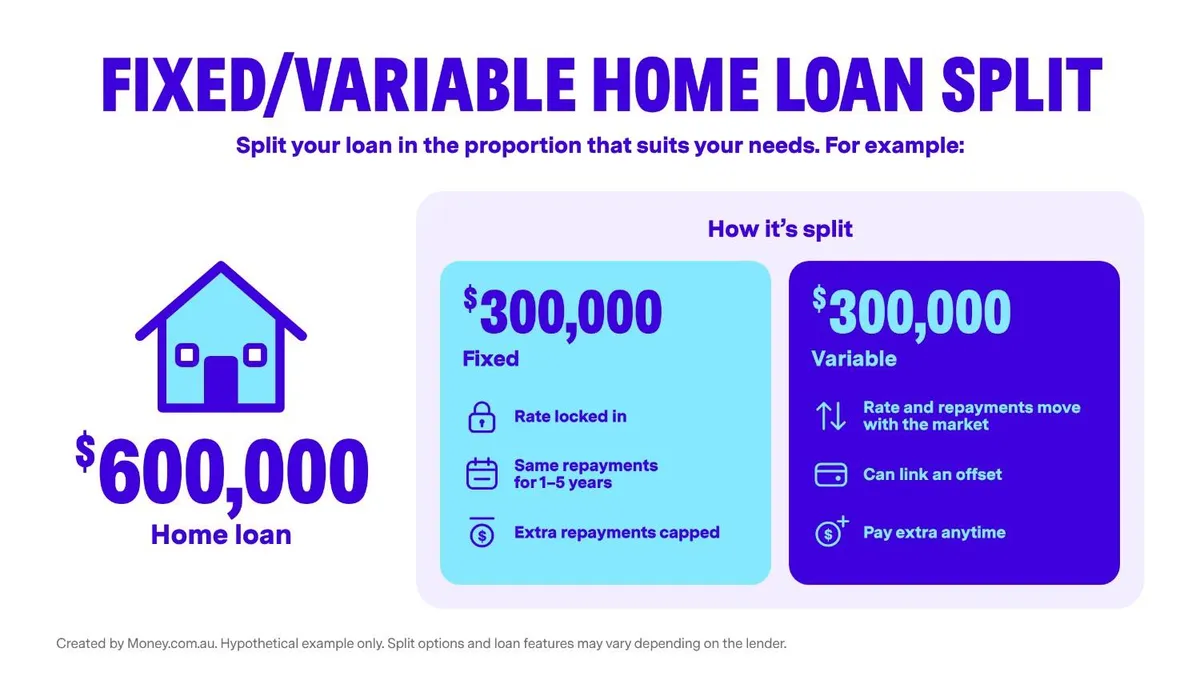
With this split, you lock in a fixed rate on part of your balance, typically for one to five years, while the rest stays on a variable rate.

If rates rise, your fixed rate stays the same until the term ends, while your variable rate may increase. If rates fall, the variable portion can benefit. Depending on the loan, the variable portion may also give you access to an offset account or more flexibility to make extra repayments.

How you divide the loan comes down to what matters more to you. Fixing a larger share gives you more predictable repayments, which can help if your budget is tight. Keeping more on a variable rate means a larger share can benefit from rate cuts, and you may have more room to pay the loan down faster.

When the fixed term ends, that portion generally reverts to a variable rate unless you arrange to fix it again. You can use our split home loan calculator to work out how it could impact your repayments.
fixed variable split

Compare home loans that allow splitting

The table below shows the lowest-rate home loans from our lender panel that allow splitting between a fixed and variable rate.

LoanInterest rateComparison rate^ Max LVR
Regional Australia Bank Home Loan without Offset Owner Occupier6.29% variable6.32%80%
Granite Home Loans *SP* Visa Holder Easy Refi6.33% variable6.74%80%
Bank Australia Clean Energy Home Loan 7.5 Star +6.38% variable6.70%90%
Granite Home Loans Visa Holders6.39% variable6.80%80%
Teachers Mutual Bank HGS Your Way Plus Fixed6.39% fixed 1 year6.85%98%
Health Professionals Bank Your Way Plus Fixed6.39% fixed 1 year6.95%80%
Teachers Mutual Bank Your Way Plus Fixed6.39% fixed 1 year6.95%80%
Newcastle Permanent Real Deal Home Loan Special6.44% variable6.48%80%
Bank of us FlexiDiscount Home Guarantee Scheme Loan Construction6.44% variable6.49%90%
Bank of us FlexiDiscount Home Guarantee Scheme Loan6.44% variable6.49%90%

Products shown allow splitting as one of their features and are based on an owner occupier who is refinancing a $500,000 loan, with principal and interest repayments and an LVR of up to 80%. Products are sorted by lowest interest rate, then lowest comparison rate. Rates shown are from Money.com.au's lender panel only.

2. Staggered fixed-term split

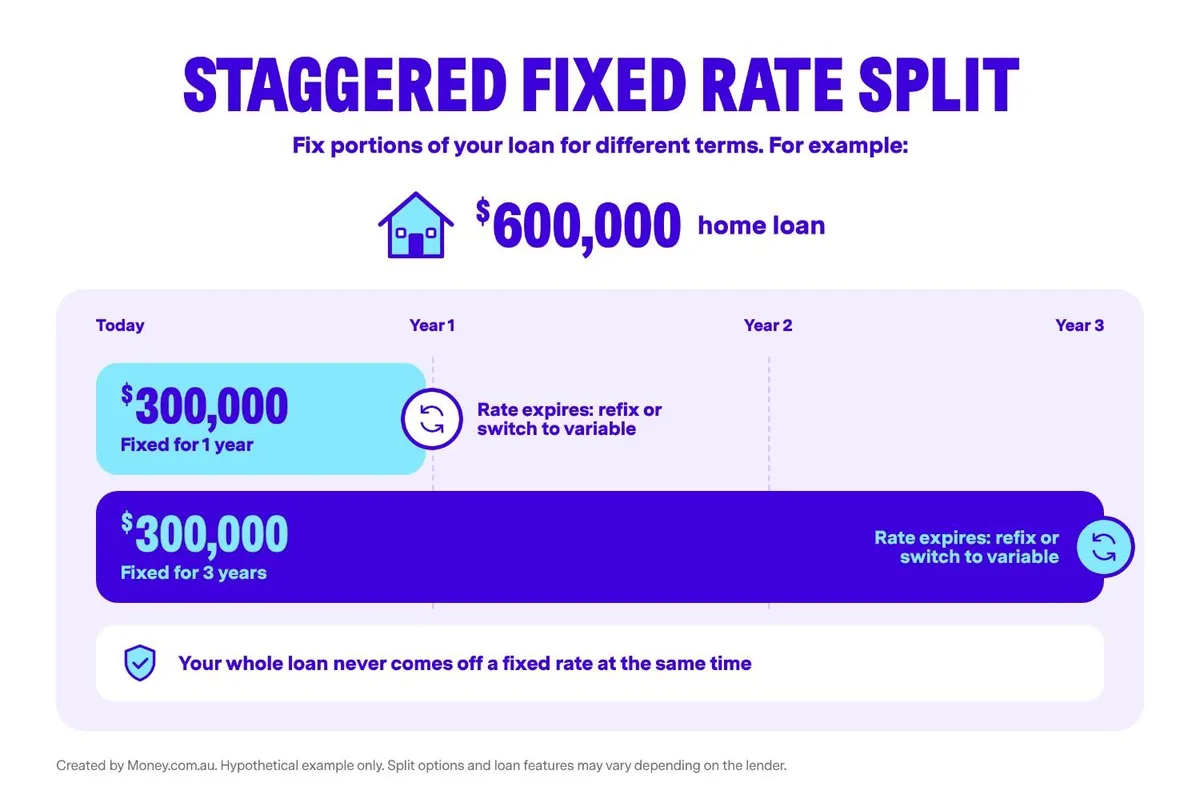
With this split, you fix portions of your loan for different lengths of time. For example, you could fix half for one year and the other half for three years. This reduces the risk of your whole balance moving off a fixed rate at once when variable rates may be high.

Check how many splits your lender allows. Bendigo Bank, for example, only allows up to two per application. A two-split limit would let you choose two fixed terms, but you’d need a third split to keep a portion on a variable rate as well. More splits also mean more rates and expiry dates to keep track of.
staggered fixed split

3. Interest-only and principal and interest split

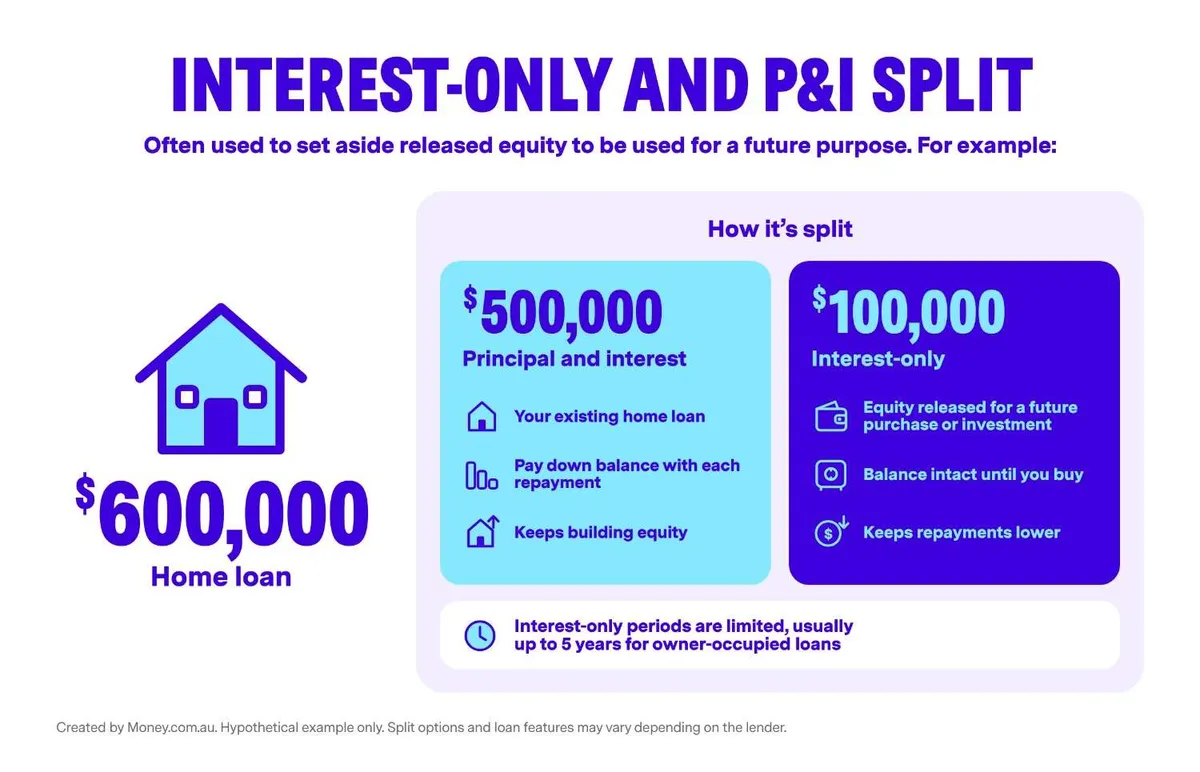
With this type of split home loan, you make principal and interest repayments on one portion and interest-only repayments on the other. One common use case is to keep paying down your main home loan while setting aside funds in an interest-only split for an upcoming purchase or project.

Doing that means you don't need to repay any of the funds before you've had chance to use them.

Interest-only periods are limited, typically to five years for owner-occupied loans, with longer periods available on some investment loans. You’ll generally pay more interest over the life of that portion, and interest-only rates are often higher than principal and interest rates.

When the interest-only period ends, repayments typically rise because you start paying down the balance over the remaining loan term.

Nick Burgess, Mortgage Broker at Money.com.au

Nick Burgess, Senior Mortgage Broker

“If you’re using equity in your home to fund an investment property deposit, you might need to have the money available before you’ve found a place to buy. Putting those funds in a separate interest-only split can keep repayments lower while you wait for settlement. Meanwhile, you can keep paying down your main home loan as usual.”

Nick Burgess, Senior Mortgage Broker
interest only split

4. Owner-occupied and investment split

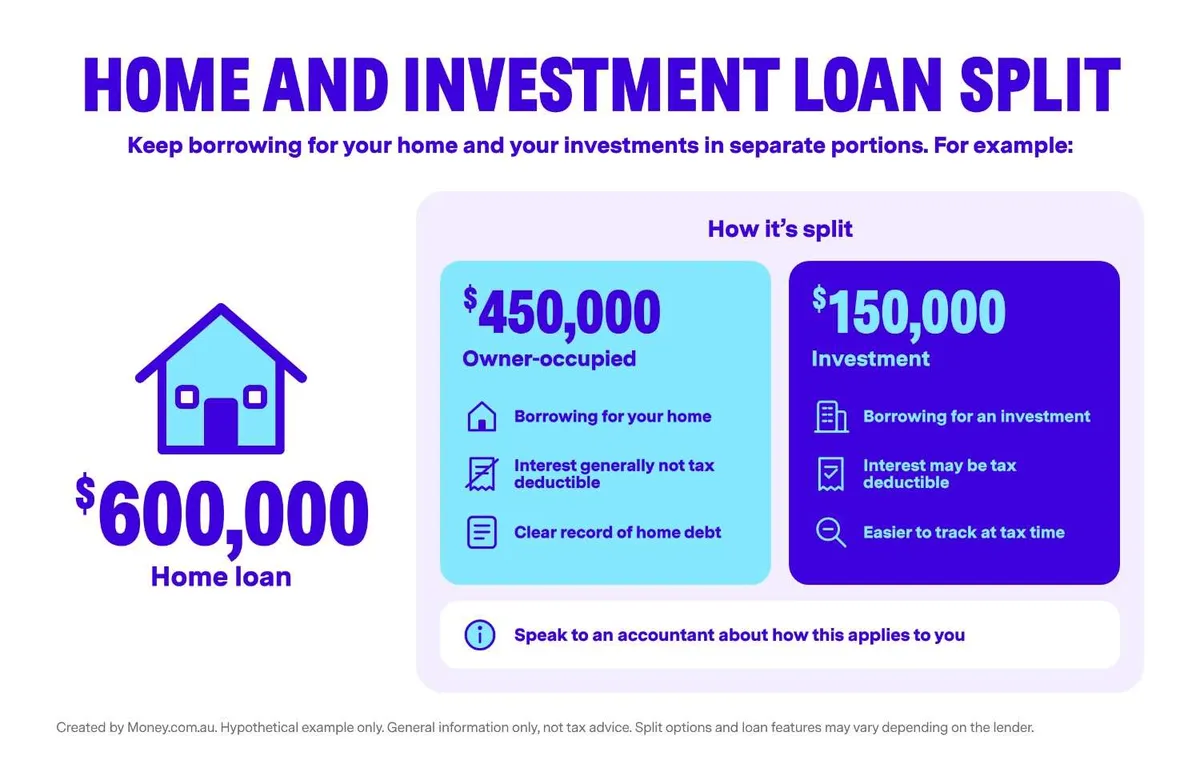
With this split, you keep the money you borrowed for your home in one portion and the money you borrowed to invest in another. For example, if you use equity in your home to fund an investment property deposit, you could put the deposit funds in a separate split.

The main benefit is being able to track what each portion was used for. Interest on the investment portion may be tax deductible, depending on how you use the funds, while interest on borrowing for your own home generally isn’t. Keeping the balances separate makes it easier to work out the interest attributable to each purpose. Speak to an accountant about how this applies to you.
purpose split

5. Separate debt or purpose split

With this split, you set aside part of your home loan for a specific purpose, such as consolidating a separate debt or paying for a renovation. The idea is you can separately track how you're paying down that portion of the overall debt and ideally contribute extra to pay it off sooner than the rest of your mortgage.

If your lender requires both portions to have the same loan term, the minimum repayment will be based on that full term. To clear a consolidated five-year car loan in five years, for example, you’d need to pay more than the minimum on that split. Paying only the minimum could mean paying more interest overall, even at a lower rate.

A limited number of lenders (Westpac is one example) allow you to set different loan terms for your different splits.
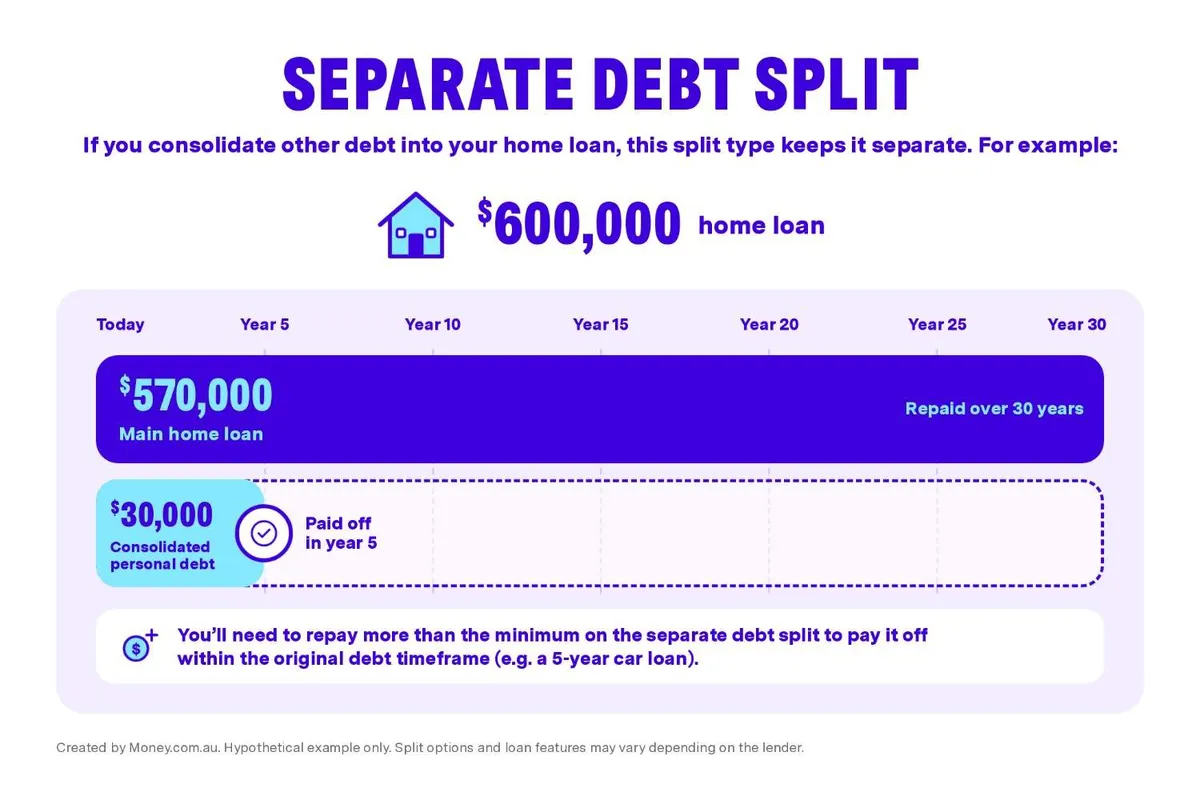
separate debt split

Case study: Using a split home loan to consolidate car finance

Katey Russo, Money.com.au Mortgage Broker

Katey Russo, Money.com.au Mortgage Broker

“A client in Queensland came to us looking to refinance her construction loan and consolidate a personal loan she’d used for landscaping. Her separate car finance was the sticking point. The repayments affected how much she could borrow, leaving her short of what she needed to refinance.

We suggested rolling the car loan into the refinanced mortgage and keeping that amount in its own split. The lender assessed the car debt over the 30-year home loan term. That lowered the required repayment enough for the refinance to work.

With the car debt in its own split, the client could make extra repayments on that portion in order to clear it within the original car loan timeframe.”

Katey Russo, Money.com.au Mortgage Broker

6. Basic variable and offset variable split

With this split, you put part of your home loan on a basic product with a low variable rate and the remainder on a product with an offset account attached.

It can suit borrowers who will have a small offset balance relative to their loan. The idea is you avoid having a home loan with offset for your entire balance, as these loans sometimes come with a higher rate.

Just bear in mind that if your savings grow beyond that portion’s outstanding balance, the excess won’t reduce interest on the basic portion.

This kind of split is pretty hard to come by, but BCU Bank is one lender in Australia that openly offers it.
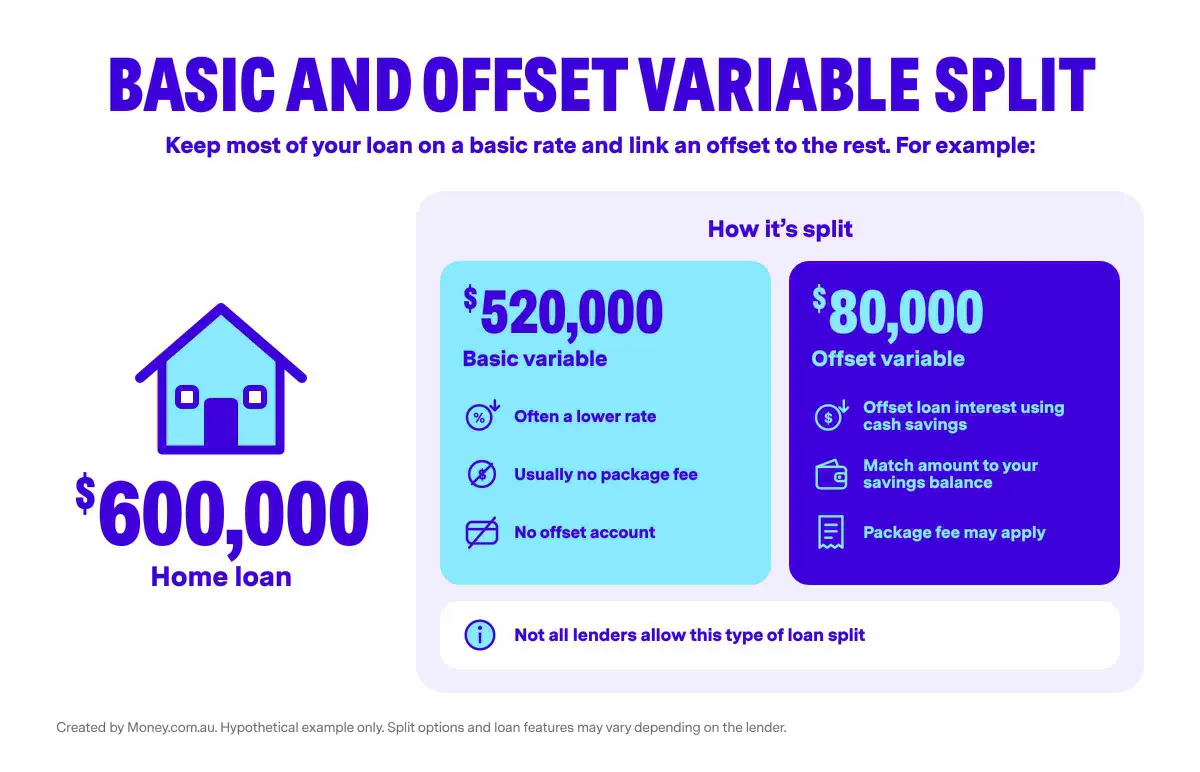
basic offset split

7. Guarantor-backed split

With this split, your loan is divided into a main portion secured by the property you buy and a smaller portion that also has the backing of a family guarantee. You make repayments on both portions.

Keeping the guarantor home loan amount separate lets you see how much is left on that portion. If your lender allows extra repayments, you may be able to pay it down faster and ask for the guarantor to be released sooner.

Check what features the lender allows across the whole loan. ANZ, for example, doesn’t allow interest-only repayments on any split in an arrangement that includes a family guarantee.
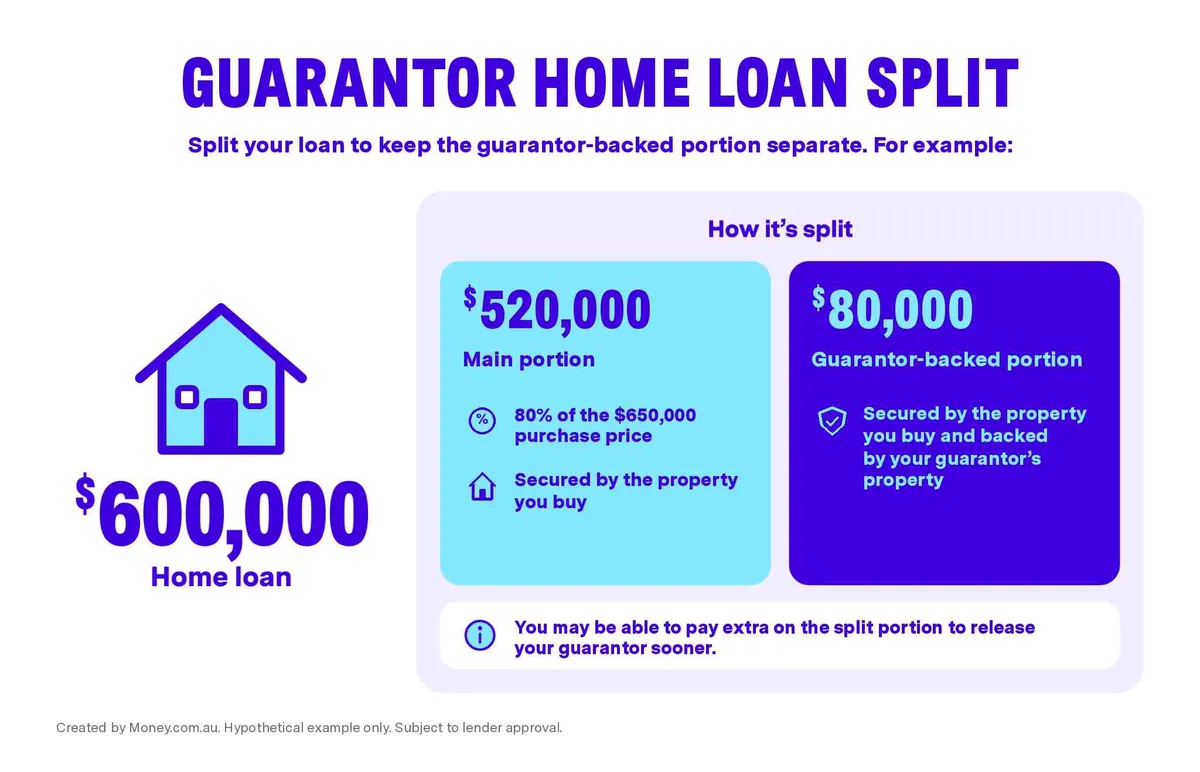

guarantor home loan split

Frequently asked questions

There’s no industry-wide maximum. Your lender sets the limit for your loan product. For example, Bendigo Bank allows up to two loan portions per Flex Home Loan application, while at the other end of the scale, Apollo allows up to 10, with a minimum of $10,000 per portion.

Yes, even if your home loan can be split, your lender may restrict which products you can combine. For example, CommBank allows eligible borrowers to split an existing loan into multiple Standard Variable portions, but its rules exclude multiple Extra Variable portions.

More broadly, across Money.com.au’s database only 51% of basic variable home loans are eligible to be split, compared with 88% of offset variable loans and 91% of fixed loans.

It can as some lenders will charge a fee per loan included in the split, so a fee on the variable part and another on the fixed portion, for example.

Check whether fees apply to the whole loan or to each portion. For example, Bendigo Bank charges one establishment fee for Flex portions set up in the same application, but charges $15 a month per loan account, meaning a split made up of two portions would cost $30 a month in service fees.

Yes, if your lender allows it. The same portion can differ from the rest of your loan in more than one way. For example, you could keep paying principal and interest on your main home loan and set up a separate interest-only portion for an investment property deposit.

Macquarie Bank, for example, is particularly flexible in this respect and allows each loan account to have its own purpose, rate type and repayment type.

Yes, if your existing loan is eligible. You can ask your current lender to split it without refinancing. NAB, for example, lets eligible borrowers create a fixed and variable split in its app. If your loan is already fixed, check whether splitting it before the fixed term ends would trigger a break cost.

Most lenders will require a new application if the split involves increasing the overall loan amount or other changes that could involve you paying more per month or increasing the loan term.

Sean Callery is the Editor of Money.com.au. He has over 15 years of international experience in journalism and personal finance. He holds a Diploma of Finance and Mortgage Broking Management (FNS50322) and is compliant to provide general advice in Tier 1 General Insurance (RG 146) products.
Nick Burgess is an experienced Senior Mortgage Broker at Money.com.au. Whether he's negotiating directly with lenders or walking a first home buyer through the process step by step, Nick's goal is always the same — clear, practical guidance that leads to confident decisions.

Important Disclosures

^Comparison rate warning

Home loan comparison rates are calculated based on a loan amount of $150,000 repaid over a 25-year term with monthly repayments. The comparison rates only apply to the examples given. Different loan amounts and terms will result in different comparison rates. Costs such as redraw fees or early repayment fees and cost savings such as fee waivers are not included in the comparison rate but may influence the cost of the loan. Check with the provider for full loan details, including rates, fees, eligibility and terms and conditions to make sure the product is right for you.

General information only The information on this page is general in nature and has been prepared without considering your objectives, financial situation or needs. You should consider whether the information provided and the nature of any home loan product is suitable for you and seek independent financial advice if necessary.

We are not providing you with a recommendation or suggestion about a particular home loan. You should read the relevant disclosure statements or other offer documents before deciding whether to apply for or continue to use a particular product.

What products, features and information are shown We show product information from the providers in our lending panel and do not include all lenders in the market. Our product comparisons may not compare all home loan features and attributes relevant to you.

Product information, such as interest rates, fees and charges, is subject to change without notice. Before acting on any information, you should confirm the relevant product information with the lender.

How home loans are sorted and filtered by default When results load initially in our home loan comparison tables, we show relevant loans from our sponsored partners first, then all loans on our lender panel that are available based on the table's default loan settings. By default, products are sorted as follows:

  • Lowest regular repayment amount, then;
  • Loans interest rate, then;
  • Lowest comparison rate, then;
  • Provider name (A-Z)

Home loan products listed in our tables are available through a mortgage broker. Mortgage brokers cannot offer loans from every provider and there may be more suitable loans for your personal circumstances.

Mortgage brokers are not authorised by Money Pty Ltd's Australian Credit Licence and operate under their own Australian Credit Licence, or as a credit representative of another Australian Credit Licensee. Mortgage brokers can make recommendations about home loan products that may suit your objectives, financial situation and needs.

Partner lenders with loans marked as ‘sponsored’ may pay a commission to Money.com.au if you click to visit their website.

If you get help from a mortgage broker as a result of visiting this page, we may earn a commission. Learn more about how we make money.