



How much does HECS debt reduce your home loan borrowing power?
HECS debt can have a significant impact on your home loan borrowing capacity, depending on your income and your HECS balance. It could mean a reduction in borrowing capacity of as much as 20% for higher earners, according to Money.com.au’s analysis.
Anyone earning above the compulsory HECS repayment threshold ($69,528 for the 2026-27 financial year) is likely to see at least some reduction to their borrowing power.
But our analysis shows the impact becomes much more noticeable the more you earn. That's because it's your income that determines how much of your HECS debt you need to pay back.
We looked at 54 different borrower scenarios across our panel of 49 lenders and found:
- At $70,000 income, having HECS debt only lowers your borrowing capacity by about 0.5% or roughly $2,000 based on the scenario we analysed.
- At $100,000 income, a HECS balance lowers your borrowing power by about 9% or roughly $48,000 based on our scenario.
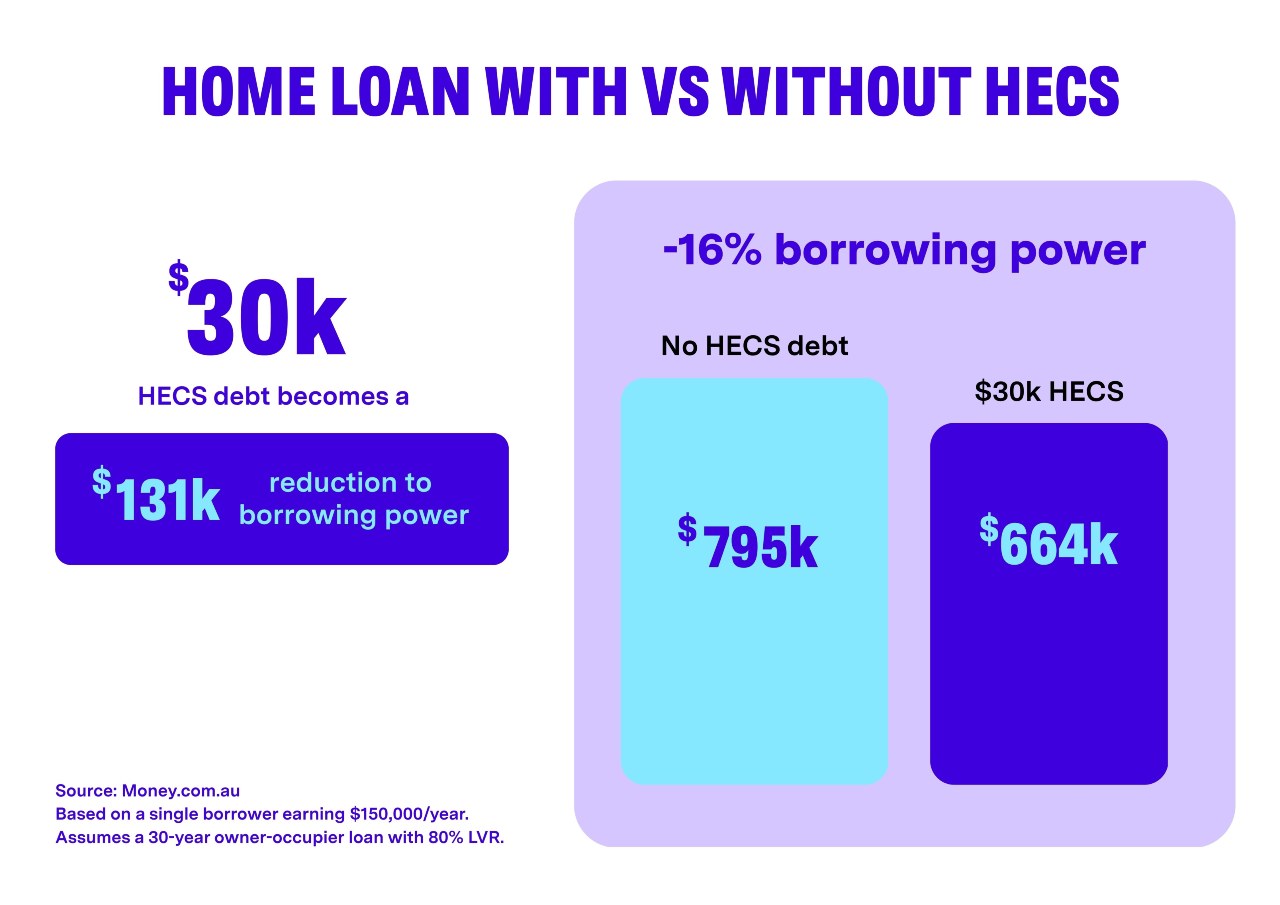
- At $150,000 income, the difference is 16% or around $131,000 less borrowing capacity.
- At $200,000 income, it's about 20% or around $208,000 less borrowing capacity.
- The actual level of HECS debt is not really a factor at all, unless it's low enough that the debt can be entirely repaid soon or is below a lender’s threshold for ignoring HECS completely.

Borrowing with and without HECS: the hit to borrowing power
The table below shows the impact that HECS debt has on borrowing capacity at different income levels.
| Income | Borrowing power (no HECS) | Borrowing power (with $30k HECS) | Difference | Reduction |
|---|---|---|---|---|
$60,000 | $269,000 | $269,000 | $0 | 0% |
$70,000 | $339,000 | $337,000 | $2,000 | 0.5% |
$80,000 | $408,000 | $391,000 | $17,000 | 4% |
$100,000 | $539,000 | $490,000 | $48,000 | 9% |
$120,000 | $635,000 | $555,000 | $80,000 | 13% |
$130,000 | $704,000 | $608,000 | $95,000 | 14% |
$150,000 | $795,000 | $664,000 | $131,000 | 16% |
$180,000 | $941,000 | $758,000 | $183,000 | 19% |
$200,000 | $1,033,000 | $825,000 | $208,000 | 20% |
How HECS debt impacts loan eligibility: Same loan, same income, a very different outcome
HECS doesn’t just affect borrowing capacity. In extreme cases, there can also be a dramatic knock-on impact on loan eligibility.
Consider two borrowers. Both earn $120,000, both want to buy the same $750,000 property with a $150,000 deposit. The only difference between them is that one has no HECS debt, and the other has a $30,000 outstanding HECS balance.
When we ran these scenarios, the borrower with no HECS debt got an initial thumbs up from every single one of the 49 lenders we on our panel.
The borrower with $50,000 in HECS debt was declined by all but one lender.
The 13% difference in borrowing capacity was enough to all but eliminate this borrower's ability to get a loan for the property they wanted.
HECS can also impact those looking to refinance their loan

Katey Russo, Mortgage Broker
"If you already have a home loan and you're planning to do some study funded through HECS, it could be worth reviewing your home loan and potentially bringing forward any refinance you may be thinking about for the future. Once you have the HECS debt, your position and options change fundamentally and you may be more limited."
Katey Russo, Mortgage Broker
How do Australian lenders actually treat HECS debt?
Each lender has its own way of assessing home loan applications and treating HECS debt. In fact, since changes were introduced by banking regulator APRA in 2025, banks have even more discretion to limit the impact of HECS on a borrower’s assessment.
This is particularly the case when it comes to the criteria for excluding HECS from the serviceability and debt to income ratio calculation.
Overall, here are the key points we uncovered as part of our analysis.
Lenders care more about your HECS repayment amount than the balance
When assessing your loan application, lenders generally calculate a fixed compulsory repayment based on your income, not your total HECS balance. Our testing found a $10,000 debt and a $90,000 debt results in almost exactly the same reduction in borrowing power. What matters most is having HECS at all, not how much of it you owe.
At lower HECS debt levels, the actual balance matters more
If your HECS balance is relatively low or due to be fully repaid within 12 months, some lenders like NAB, Westpac and CommBank will exclude the HECS debt when assessing the loan application. We’ll explain the exact lender policies below.
HECS is not treated in the same way as other debts
In some ways, lenders treat HECS payment similarly to how they'd treat a car loan repayment or any other regular expense. It’s money that you owe that is not available to be used for servicing the home loan. But in other respects HECS is treated differently to other debt.
Specifically, it’s fairly common for lenders to exclude HECS debt when they are calculating a borrower’s debt-to-income ratio. This means HECS may have much less of an impact on your ability to get a loan than a car loan or credit card might. ANZ, CommBank, ING, Westpac and St.George are among the lenders that exclude HECS debt in debt-to-income calculations.
Your choice of lender makes a big difference
Across our lender panel, the range of outcomes varied significantly. So who you decide to apply for a loan with really matters. For example, for a borrower earning $100,000 per year with a $50,000 HECS balance, there was a gap of roughly $122,000 between the most generous and most conservative lender on our panel.
The lender offering the highest borrowing power also changed around when we tested different incomes and HECS balance. So there's no single "best" lender for everyone with HECS debt.
Lender-by-lender: How your HECS debt could be viewed
Lenders that ignore your HECS debt completely if it's about to be paid off
Some lenders will exclude your HECS repayment from their borrower assessment calculations entirely, provided you can prove it's on track to be repaid within a limited time period. You may need to provide a recent myGov or ATO statement as proof.
The exact policy here differs by lender:
| Lender | Exclusion window | Requirements |
|---|---|---|
| Westpac & St.George | Within 12 months | Requires a myGov statement showing the balance. You must not be currently studying (i.e. not still accruing new HECS debt). Only used if the loan wouldn't otherwise pass servicing. It's not automatic. |
| Athena | Within 12 months | Requires an ATO portal printout no more than 30 days old, showing your balance and repayment level. Your compulsory repayments can also be added back into your before-tax income for the assessment. |
| P&N Bank | Within 12 months | Needs ATO evidence of your balance, plus sign-off from a Delegated Credit Authority (DCA) holder. Only your actual HECS/HELP debt qualifies. Other student loans (like STSL, VSL, or private study loans) don't get the same treatment. |
| Thinktank | Within 12 months | Can be waived as an exception if your debt is likely to clear within the year. This is assessed case by case rather than as a standard policy. |
| Bendigo Bank | Within 12 months (informal) | No formal exclusion policy, but if your loan fails servicing purely because of HECS and it's due to clear within 12 months, you'll need to raise it directly with the Bendigo Bank through your broker. |
| CommBank | Within 12 months | HECS is excluded from servicing entirely. Requires evidence of your outstanding balance via myGov or the ATO portal. Not available for bridging loans, refinance-exception assessments, or guarantor applications involving a company or trust. |
| Beyond Bank | Within 2 years | This is the most generous policy on the panel. HECS is excluded if it'll be fully repaid within 2 years, not just 12 months. |
| NAB | Balance of $20,000 or less | Rather than a time window, NAB will consider a servicing deficit waiver if your HECS balance is $20,000 or under and excluding it would turn a declined application into an approved one. Requires ATO evidence no more than 45 days old. Not available if you're still studying. |
Lenders offering a partial concession for HECS debts with a longer repayment timeframe
If the timeframe for repaying your HECS debt is a bit longer you may get a partial concession from your lender. That said, this is not a common policy and CommBank is currently the only lender on our panel with this type of arrangement.
| Lender | Timeframe | How it helps |
|---|---|---|
| CommBank | Debt repaid within 1–5 years | HECS still counts in your servicing calculation, but it's assessed using a reduced 1% buffer instead of CommBank's standard buffer. Not available if you or any borrower on the application already owns 5 or more investment properties. |
Lenders that don’t include HECS in debt-to-income calculations
Most lenders use debt-to-income (DTI) ratio as part of their credit assessment. It simply means if your existing debt is too high as a proportion of your income, your application may be rejected. But some lenders leave HECS out of that ratio entirely, so having HECS debt won’t necessarily hurt your approval prospects.
These are the lenders on our panel with a specific policy excluding HECS from its DTI assessment calculation.
- ANZ
- CommBank
- Westpac
- St.George
- Bank Australia
- Beyond Bank
- Newcastle Permanent
- P&N Bank
- ING
Lenders that treat HECS as a living expense, not a debt
Most lenders treat your HECS repayment as a financial commitment, similar to a loan repayment. But some lenders take a different approach, folding it in as part of your living expenses instead.
| Lender(s) | How HECS is treated |
|---|---|
| Auswide Bank & MyState | Recorded as an education expense, sitting outside the lender's standard living-expense benchmark. |
| Granite, Zeus & WLTH | Listed as a "specifically excluded expense" — it has to be accounted for separately rather than folded into your general living costs. |
| Bank of Us | Treated as a discretionary expense once it exceeds $1,000 a year. |
Should you pay off HECS before applying for a home loan?
If your borrowing capacity is tight, or your main goal is to maximise the amount you can borrow, paying off your HECS debt entirely, or reducing your balance to meet lender thresholds, is worth serious consideration.
In fact, our analysis shows it will do far more for your borrowing power than putting the same money towards your deposit instead. The reason for this is that having no HECS debt means you have increased capacity to make higher regular loan repayments, whereas having a larger home deposit doesn’t move this needle in the same way.
Of course, there are other considerations, including the fact that leaving your HECS debt alone and maximising your home deposit instead would mean keeping your loan-to-value ratio low.
This can have its own benefits. For example, in our testing we found that taking money away from your home deposit to lower HECS debt and meaningfully increasing your LVR in the process meant a handful of lenders began to offer less competitive interest rates. Leaving the deposit intact meant lower rates, which would lower your overall loan costs over the time.
Using money to pay down HECS debt vs putting it towards your home deposit
To see how this plays out in practice, we looked at five different possible scenarios for a borrower earning $130,000 with a $50,000 HECS debt.
| Scenario | Borrowing power |
|---|---|
Pay off the $50,000 HECS debt in full | $704,000 |
Repay $40,000 of HECS, put $10,000 towards deposit | $610,000 |
Repay $30,000 of HECS, put $20,000 towards deposit | $608,000 |
Repay $10,000 of HECS, put $40,000 towards deposit | $609,000 |
Repay $0 debt, of HECS put $40,000 towards deposit | $609,000 |
Are there other debts you could pay down first?

Nick Burgess, Senior Mortgage Broker
"If you have other non-HECS debt, like personal loans or credit card limits, consider getting these down first. Other types of debt are likely to be costing you much more in interest, and because of how lenders treat HECS versus other debt, they’re probably hurting your borrowing capacity more too. Getting rid of unused credit card limits is usually our first port of call when we’re looking to help our clients meet lenders’ servicing requirements and maximise their borrowing power."
Nick Burgess, Senior Mortgage Broker
Other ways to improve your borrowing capacity
Your HECS debt (or lack of it) is just one of many factors that can impact how much you can borrow with a home loan. Here are some other ways you may be able to maximise how much you can borrow, if needed.
- Maximise your income if you can: Is it time to chat to your employer about an overdue pay rise?
- Reduce unused credit limits: If you have a large credit card limit you don’t need, consider lowering it or getting rid of the credit card until your home loan application is done and dusted.
- Reduce ongoing expenses: Keep your budget as lean as you can in the run up to applying for your home loan
- Apply for the First Home Guarantee, which means you may be able to get a loan with a deposit of as little as 5% of the property’s value with no lender’s mortgage insurance. If the alternative is needing a deposit of 20%, using the guarantee scheme means being able to borrow more than you otherwise would be.
Of course, if you need guidance based on your own situation, you can have a no-obligation with a Money.com.au mortgage broker. They’ll be able to assess your position and discuss strategies to match.